News —
From the digital car key to the smart sensor platform
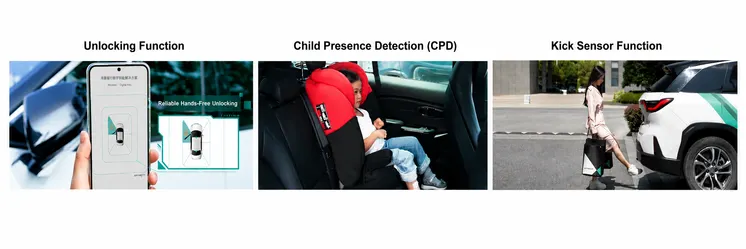
The traditional car key is gradually losing its unique selling point. Even today, smartphones and digital keys are increasingly replacing physical keys in vehicles. But the real development is just beginning. Ultra Wideband, or UWB for short, is no longer a vision of the future - it is becoming the new standard for modern vehicle architectures. Competition is no longer about whether UWB is used, but rather how efficiently the technology is integrated into the vehicle and how it can be utilized for as many functions as possible simultaneously.
This is precisely where the real momentum lies: a technology originally designed for vehicle access is evolving into a shared infrastructure for security, convenience, and software-based vehicle functions. This gives automakers the opportunity to merge previously separate systems onto a common technological foundation. The automotive electronics specialist JOYNEXT, based in Dresden, has therefore long since moved beyond working solely on the digital car key to developing platforms that intelligently connect the vehicle, the driver, and the interior. In this way, the digital key is evolving from a convenience feature into a central component of the software-defined vehicle.
Precision becomes a decisive competitive factor
The digitization of vehicle access began with radio remote controls and later with keyless entry systems. These solutions simplified everyday life; however, they also had vulnerabilities. In particular, so-called relay attacks demonstrated that traditional radio systems no longer met rising security requirements. In these attacks, attackers extend the radio signal between the vehicle and the key, thereby tricking the vehicle into believing a physical proximity that does not actually exist.
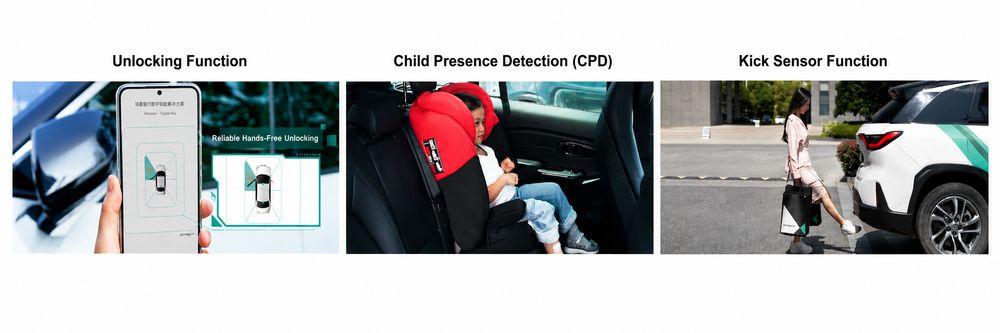
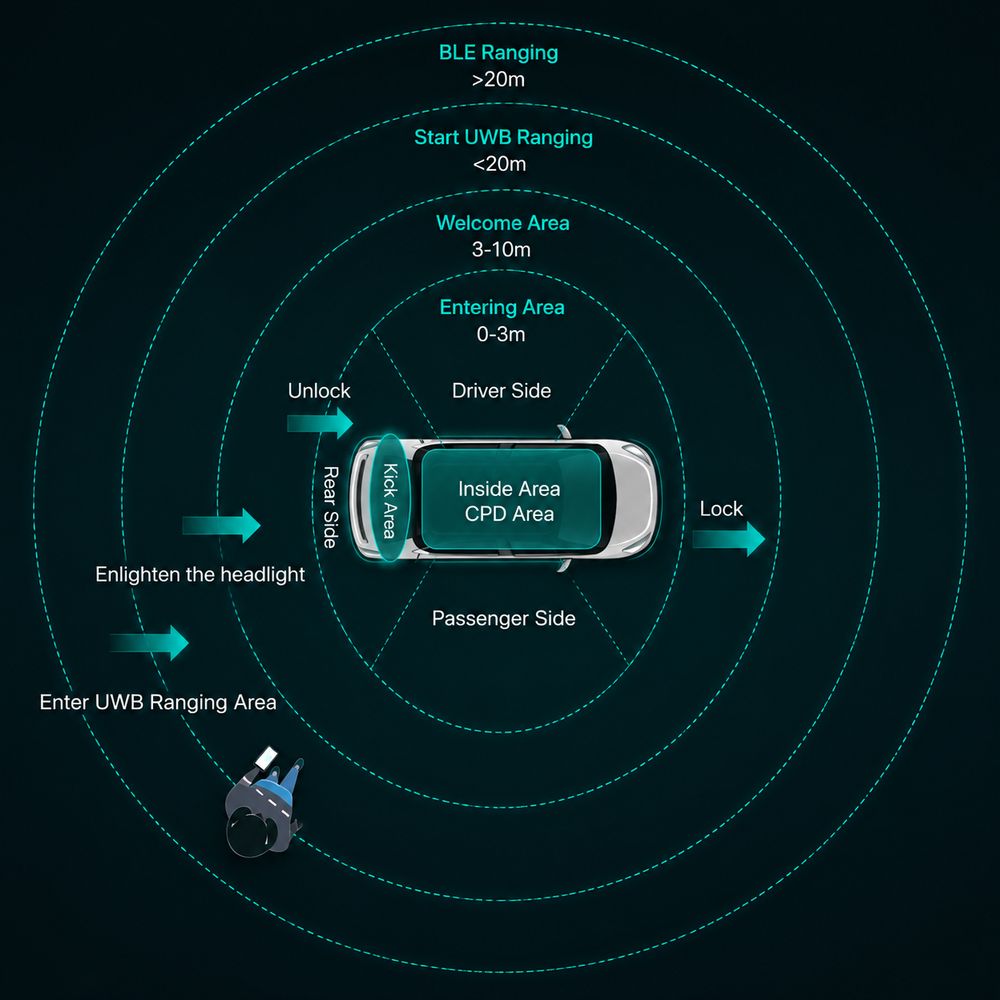
Ultra Wideband (UWB) fundamentally changes this principle. Unlike conventional radio systems, UWB not only measures signal strength but also determines the actual transit time of the signals between the smartphone and the vehicle. This allows the distance to be determined with an accuracy of just a few centimeters. As a result, the vehicle can not only detect whether an authorized key is present but also whether it is actually outside, inside, or at a specific location on the vehicle. It is precisely this spatial information that is becoming increasingly important for modern vehicles. It determines whether doors are unlocked, whether the engine may be started, or whether certain convenience features are automatically activated. As a result, vehicle access is evolving from simple authentication to a system that understands spatial context.
Technically, this precision is achieved through the interaction of several technologies. Bluetooth Low Energy (BLE for short) handles the energy-efficient initial connection between the smartphone and the vehicle. Only when the user approaches does the vehicle activate UWB communication for precise distance measurement. This is supplemented by secure hardware components for authentication, as well as cloud services for access management and digital key sharing. It is this interplay that makes a cross-brand digital key practically usable in the first place. At the same time, the Car Connectivity Consortium (CCC) standard, for example, ensures that Android smartphones, iPhones, and various vehicle platforms work together seamlessly. As a result, UWB is increasingly evolving from a standalone technology into a global ecosystem for secure vehicle access.
From sensors to system expertise
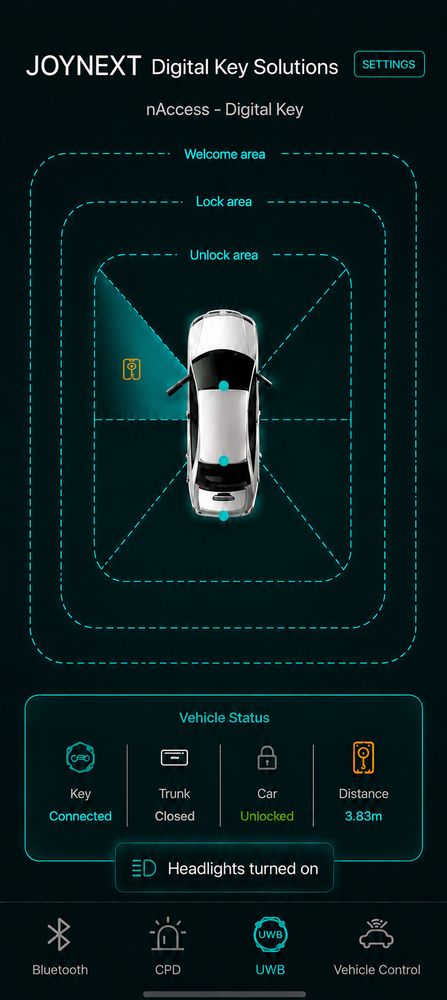
From a technical perspective, UWB is now considered an established state-of-the-art technology. The real challenge today lies less in the radio technology itself and more in its cost-effective and robust integration into the vehicle. This is precisely where the focus of development work has shifted in recent years. While the initial focus was on introducing UWB technology, the primary concern today is its cost-effective implementation in production vehicles. “What’s needed are solutions that require as little hardware as possible, support various vehicle platforms, and can simultaneously integrate additional functions,” says Jens Wagner, Director of Research and Development at JOYNEXT GmbH. As a result, competition is increasingly shifting from radio technology to the quality of the system architecture and the underlying software.
This is precisely where JOYNEXT comes in. “Our innovation lies in translating the technology’s added value into more complex designs that enable a more efficient overall architecture with significant cost-saving potential - while still meeting market demands,” says Lars Franke, Product Manager at JOYNEXT GmbH. This is an attractive prospect for vehicle manufacturers, as fewer UWB beacons mean lower hardware costs and reduced space requirements. JOYNEXT also utilizes modern signal processing, sophisticated algorithms, and a powerful software architecture to achieve maximum precision with a significantly reduced number of UWB beacons. This lowers hardware costs for OEMs while laying the foundation for scalable smart access and sensing solutions across various vehicle platforms.
However, JOYNEXT’s strength lies not only in UWB technology, but in its reliable implementation for mass production. JOYNEXT ensures that precise localization and reliable sensing functions are consistently available even under demanding real-world operating conditions. Whether dealing with different body structures, metallized windows, or widely varying vehicle loads, the system architecture is designed to reliably handle a wide variety of installation situations and usage scenarios. This provides vehicle manufacturers with a production-ready platform that equally supports different vehicle concepts, installation scenarios, and use cases, while laying the foundation for future smart access and sensing functions.
Another advantage stems from the reusability of the existing hardware. The same UWB components installed for secure vehicle access can simultaneously be used for numerous other applications. From the manufacturers’ perspective, this significantly improves cost-effectiveness because it eliminates the need for additional sensors. The added value therefore lies not solely in a single convenience or safety feature, but in the fact that the same hardware combines several previously separate vehicle functions. It is precisely this multi-use capability that is considered one of the most important development trends in modern vehicle architectures.
An access technology gives rise to a new sensor platform
The current momentum of UWB begins where the technology moves beyond vehicle access and becomes a sensor platform. In addition to precise distance measurement, so-called UWB radar sensing is increasingly being developed. In this context, the vehicle no longer communicates solely with a digital key but analyzes reflected UWB signals to detect movements, gestures, or even subtle vital signs.
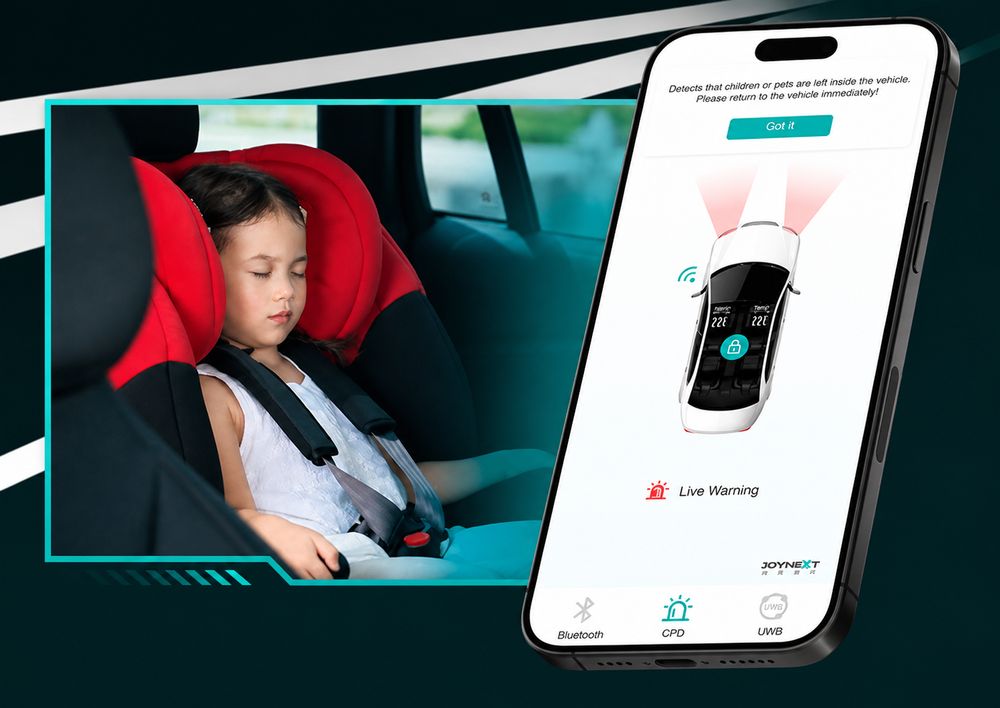
This development is particularly evident in “Child Presence Detection” (CPD) - a system that, after the vehicle has been locked and the occupants have exited, checks whether children or animals have been left behind in the vehicle and provides appropriate alerts to prevent life-threatening situations in vehicles that are heating up. This is driven by stricter Euro NCAP requirements, which mandate that vehicles be equipped with appropriate safety systems. Until now, additional 60-gigahertz radar sensors have typically been installed for CPD. While these sensors perform their task reliably, they also incur additional hardware costs and increase the complexity of the vehicle architecture. JOYNEXT is therefore taking a different approach. The UWB components already installed for digital vehicle access also handle interior monitoring tasks simultaneously. This creates a shared sensor platform that supports both vehicle access and interior monitoring for CPD. The real added value thus lies not only in an additional safety feature, but in the multiple use of the same hardware and technology for different applications.
Furthermore, the same infrastructure opens the door to additional applications. The vehicle can detect unauthorized movements inside the cabin, interpret gestures for operation, track seat occupancy, or uniquely authenticate the user during automated parking. More precise vehicle location in parking garages and the secure activation of digital services related to vehicle charging, fleet management, or valet parking also benefit from accurate positioning.
An interesting development is emerging from China. There, regulatory requirements restrict the use of certain 60-gigahertz interior radars. Consequently, UWB-based solutions for interior security and vehicle access are gaining significance much sooner. Experience from these development programs is increasingly being incorporated into European vehicle platforms and is accelerating the further development of corresponding system concepts. What is noteworthy here is not so much each individual use case as the common technological foundation. Once installed, a UWB infrastructure lays the groundwork for a continuously growing software portfolio. New functions can be added later via software without requiring additional sensors. This principle aligns perfectly with the development of software-defined vehicles, in which hardware is used for as long as possible, and the range of functions is continuously expanded.
UWB is evolving into the infrastructure for future vehicle architectures
Ultra Wideband has long been more than just a convenience feature for the digital car key. The technology combines precise localization, high security, and intelligent sensor technology on a single platform. This creates an infrastructure that links vehicle access, interior security, and new, software-based services. “For automakers, the added value lies not only in individual functions, but in the ability to reuse the same hardware for numerous applications while simultaneously reducing costs, complexity, and space requirements,” says Jens Wagner. “This is precisely where our system approach comes into play. The reduction in the number of UWB anchors required while maintaining the same performance exemplifies that the future will be shaped less by additional hardware and more by intelligent system integration,” adds Wagner.
With the transition to the software-defined vehicle, the role of Ultra Wideband is thus also undergoing a fundamental change. The technology is evolving from an access solution to a central infrastructure for localization, safety, and intelligent vehicle interaction. In the future, what matters will no longer be how many sensors a vehicle has, but how intelligently their information can be integrated and utilized for various applications. This is precisely where the real paradigm shift lies. The next-generation digital car key does more than just open doors. It lays the foundation for vehicles to understand their users, correctly assess situations, and, based on this, act more safely, economically, and intelligently.
Read the article in HANSER automotive: Vom digitalen Autoschlüssel zur intelligenten Sensorplattform