Blog post —
Technology alone does not improve vessel performance. People do.
You already know how to operate your vessel. Years of real-world experience have taught you how weather, sea conditions, traffic, and operational demands affect performance at sea. But as fuel efficiency and cost demands continue to rise, visibility matters more than ever. What if data-driven insights could help you stay one step ahead?
You know your vessel. Data helps you understand it even better.
If you have spent years operating vessels, you already know something important: No two voyages are ever exactly the same. Weather changes, sea conditions change, traffic changes, and operational priorities change. And over time, every captain and crew develops their own experience, instincts, and way of operating a vessel efficiently and safely. That experience is invaluable. Because when it comes to real-world operations at sea, no software can replace human judgment.
But even the most experienced operators face one challenge: It is incredibly difficult to see long-term operational patterns while managing day-to-day operations in real time. That is where data-driven insights can make a real difference.
Why vessel performance depends on both experience and data
Let’s be clear: Maritime optimization is not about technology telling captains how to do their jobs. And it is not about replacing experience with algorithms. In fact, the most valuable optimization happens when operational expertise and data work together.
What platforms like iHelm can do is help uncover patterns that are difficult to detect manually over time: small variations in speed adjustments, engine usage, acceleration, and operational decisions under different conditions.
Because sometimes even small operational variations can have a surprisingly large impact on fuel consumption over weeks, months, and across entire fleets.
Experience tells you what feels right. Data helps explain why.
One of the biggest misconceptions about vessel optimization is that technology exists to “override” the people onboard. The reality is the opposite. The people on board are essential. Without the experience of captains and crews, operational data has very little meaning.
But when experience is combined with data, something interesting happens: You gain the ability to validate assumptions, compare patterns over time, and identify opportunities that would otherwise remain invisible.
Not because operators lack knowledge – but because nobody can manually track every operational variable across every voyage. Data simply adds another layer of understanding.
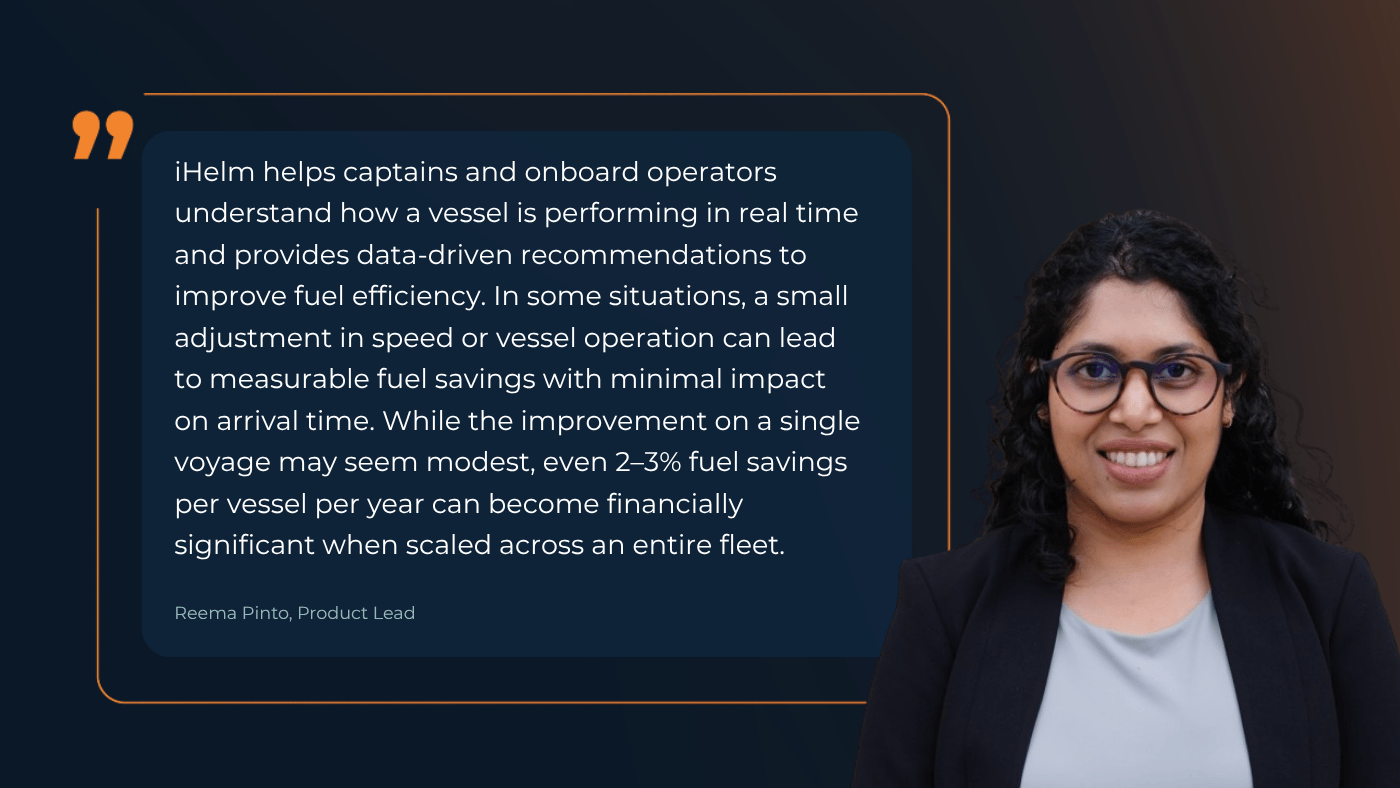
Why crew adoption is critical for vessel optimization
For shipping companies investing in digital solutions, one thing is becoming increasingly clear: Technology alone does not create fuel savings. People do.
If onboard crews do not trust the recommendations, engage with the insights, or see value in the system, even the best technology will struggle to create measurable results.
That is why successful maritime optimization is not only about software. It is also about collaboration. The goal should never be: “The system knows better.” The goal should be: “Can data help all of us understand vessel performance more clearly?” That shift in mindset changes everything.
The future of vessel performance optimization
As shipping continues to evolve, data-driven operations will become increasingly important. But the future will not belong to companies that simply collect the most data. It will belong to the companies that successfully combine:
- Operational expertise onboard
- Practical real-world experience
- Intelligent analysis
- Continuous learning
Because ultimately, the strongest operational decisions are not made by humans or technology alone. They are made when both work together.