




Skip to content

News archive

  • Tracking the impact of the digital revolution

    The second session of the 2016 Foundation Seminar Series (FSS) took place on 13–14 October in the premises of the Federal Ministry of Labour and Social Affairs in Berlin.
    The event continued and built on the progress made at the first session, in Dublin in May, on the theme ‘The impact of digitalisation in the European Union: Building up national agendas for better implementation of digital cha

  • High cost of lower female employment

    The EU would be an estimated €370 billion better off each year if the employment rate of womenequalled that of men.
    This figure, which is equal to 2.8% of EU GDP, is the sum of income not earned and welfarecontributions not made plus the cost of welfare transfers. (It does not, however, take account ofthe economic contribution of women not active in the labour market.) The finding comes from aE

  • The gender employment gap – an issue that affects us all

    In the following blog piece Eurofound Director Juan Menéndez-Valdés looks at the issue of the gender employment gap in Europe, and how the difference in labour market participation between women and men has far-reaching implications.

  • Il nuovo rapporto di Eurofound - The Gender Employment Gap: Challenges and solutions

    Il nuovo rapporto di Eurofound – "Gender Employment Gap: challenges and solutions” è stato presentato al Parlamento Europeo martedì 11 Ottobre 2016.
    Nonostante il tasso di occupazione femminile sia aumentato durante la crisi economica, la divergenza nell’occupazione tra uomini e donne in Europa e nella maggior parte dei paeasi membri è ancora significativa. A questo proposito, il rapporto si co

  • Gender employment gap costs Europe €370 billion per year

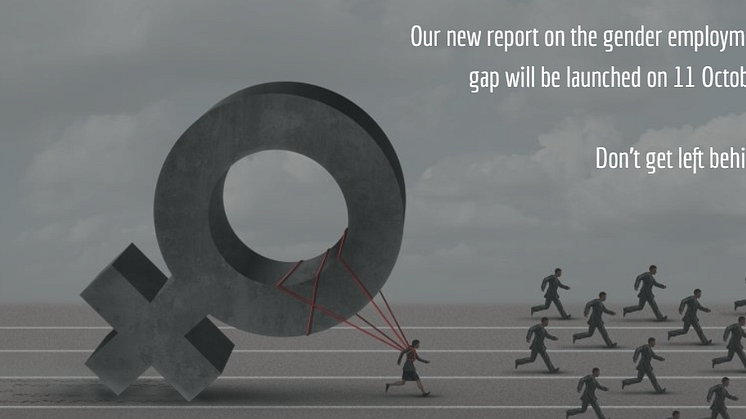
    Our new report explores the main characteristics and consequences of gender gaps in labour market participation. It finds that the estimated cost of a lower female employment rate was €370 billion in 2013, corresponding to 2.8% of EU GDP. This does not include the unpaid domestic work performed by women who are not active in the labour market.

  • Publication alert - The gender employment gap: Challenges and solutions

    Eurofound's new publication The gender employment gap: Challenges and solutions will be presented to the European Parliament's Committee on Women's Rights and Gender Equality tomorrow at 5.00 pm (CET), and will subsequently be available to download directly from our website. Watch the presentation live at http://bit.ly/FEMMComm.
    For further information please contact either our promotions team,

  • Trust and dialogue are the secrets to business success in times of crisis

    In the following blog piece Eurofound Senior Programme Manager Stavroula Demetriades looks at the relationship between social dialogue and business success, particularly during times of crisis. 
    Europe has gone through significant economic change over the past decade. Businesses have had to manage the challenges posed by the financial crisis, globalisation and a rapidly changing labour market. 

  • Making work more sustainable throughout the life course

    European countries face the challenges of ageing populations supported by shrinking workforces, more precarious types of employment, and in many cases, a decreasing number of jobs in the wake of the economic crisis. As a result, the issue of how to enable more people to participate in the labour market and to continue to do so until an older age has become a key policy issue in all EU Member State

  • Fewer routine jobs but more routine work

    In the following blog piece, originally posted on Social Europe Journal, Martina Bisello and Enrique Fernández-Macías look at the impact of routine tasks on working life, and how routine fits into the larger debate on computerisation and automation. 
    In the digital age, there are fewer routine jobs because of a higher risk of automation. But a great paradox of this age is this: workers in most

  • Working longer by working less?

    In the following blog piece, originally posted in Social Europe Journal, Eurofound Research Manager Hans Dubois looks at the potential of partial-retirement to extend working lives in Europe, and improve the sustainability of pension schemes.  
    There are limits to the effectiveness of member states’ pension reforms…
    Europe, it’s often said, is experiencing a worsening ageing crisis. European

  • Charting the state of housing across the EU

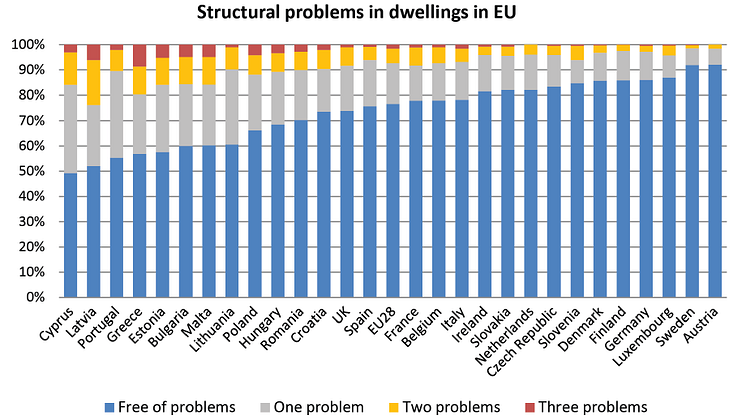
    The prevalence of structural problems in dwellings in the EU varies considerably between Member States.
    On average, 12% of EU residents report damp or leaks in their walls and roofs; 9% live in accommodation with rot in the windows, doors or floors; and 14% of resident indicate that they cannot afford to keep their home adequately warm.
    Such problems are most common in Cyprus, where 51% of d

  • A year in review – working life in 2015

    A new report from Eurofound – Developments in working life in Europe: EurWORK annual review 2015 – collates information based on research from Eurofound’s network of European correspondents. The correspondents report national-level information on industrial relations and working conditions for the Agency’s European Observatory of Working Life (EurWORK).
    The material, published in the form of a

Show more