Blog post -
Inclusive circularity: designing circular systems that work for both people and planet
The path to net zero isn’t only about cutting carbon, it’s about redesigning the systems that shape our lives. In fashion, this means rethinking how we make, use and value materials, and ensuring that the shift to circularity includes the people who make this industry what it is, valuing their expertise and experience.
While renewable energy and efficiency measures can cut about 55% of global emissions, the remaining 45% come from how we design, make and use products, according to research by the Ellen MacArthur Foundation. Transforming our material world, including fashion, is essential to reaching net zero, and circularity plays a vital role.
By decoupling growth from the production of new garments, circular business models such as rental, repair, resale and remaking could grow to 23% of the market by 2030, representing a USD 700 billion opportunity. This shift alone could cut fashion’s emissions by up to 16%, roughly a third of what’s needed for a 1.5-degree pathway. However, when the fashion industry talks about circularity, the focus often falls on fibres, fabrics and technologies while a truly circular system doesn’t begin or end with materials - it starts and ends with people.

Why inclusion matters in circularity
As the textile industry races to decarbonise, digitalise, and redefine itself through circularity, we face a critical question: will this transformation be fair for the people and communities most affected by it? While the textile industry must drastically cut its emissions by halving greenhouse gas emissions every decade until 2050 (in line with the Carbon Law) it must also ensure social equity for the millions of people whose livelihoods depend on it (as highlighted in the Earth4All framework). Tackling the climate crisis means transforming the entire system, ensuring economic security, social protection and gender equality alongside environmental action.
Circularity is often seen as a technical fix focused on new materials, better recycling and closed loops. But without people at its core, it risks deepening the very inequalities it can help to solve. Inclusive circularity is our response to that challenge. It means designing circular systems that decarbonise production, reduce waste and pollution, reuse materials, and at the same time improve livelihoods, resilience and wellbeing. And a just transition also goes beyond the factory floor. In the fashion industry, conversations tend to focus on upskilling for circularity, preparing for automation or improving working conditions. But real justice means recognising that workers are also parents, carers and citizens: human beings with dreams, communities and basic needs such as housing, health, clean water, safety and joy.
Putting inclusion into practice
The H&M Foundation works across the textile value chain to showcase how this can be done. Our three large projects across India and Bangladesh demonstrate how inclusive circularity can take shape in different contexts, each addressing a distinct stage of the textile industry’s value chain.
Bengaluru, India: inclusion at the start of the loop
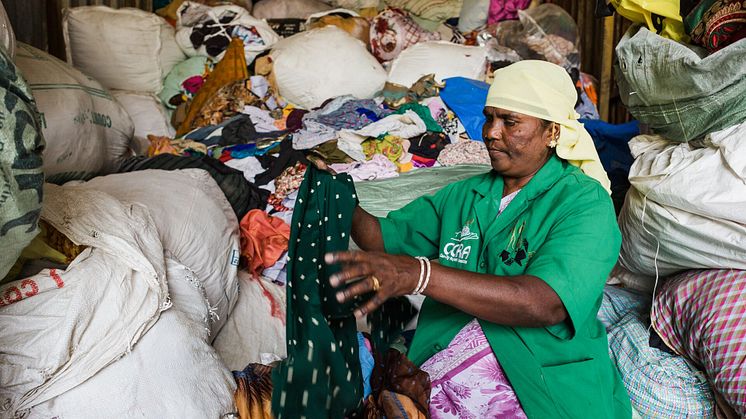
In India alone, 62 million tons of waste is generated annually, and only 19% of the waste is processed and treated, the rest ends up in landfills. The largest driving force behind recycling is the roughly 1.5-4 million informal waste pickers. In Bengaluru, thousands of informal waste pickers work at the very beginning of the circular economy. They collect and sort recyclable materials that re-enter production systems, yet their contribution has long gone unrecognised.
Saamuhika Shakti, a first-of-its-kind collective impact initiative, brings together local NGOs, recyclers and experts to design circular solutions with waste pickers at the centre. The goal is to equip informal waste pickers to lift themselves out of poverty, bring them closer to the formal sector, and provide the textile industry with sustainably sourced recycled materials.

Since 2020, the initiative has reached more than 35,000 people in waste-picking communities, creating opportunities for families to thrive while improving recycling rates and reducing landfill waste. Post-consumer PET waste collected by waste pickers is sold to the social enterprise Hasiru Dala Innovations, where it is flaked, washed and supplied to button manufacturers for global retailers. So far, this has resulted in more than 150 million buttons, showing how materials once considered waste can create value, livelihoods and a powerful business case.
Inclusive circularity here means visibility, security and respect. When those who keep materials in circulation are treated as essential partners rather than invisible labour, circularity becomes not only cleaner but fairer.
Dhaka, Bangladesh: inclusion at the heart of production
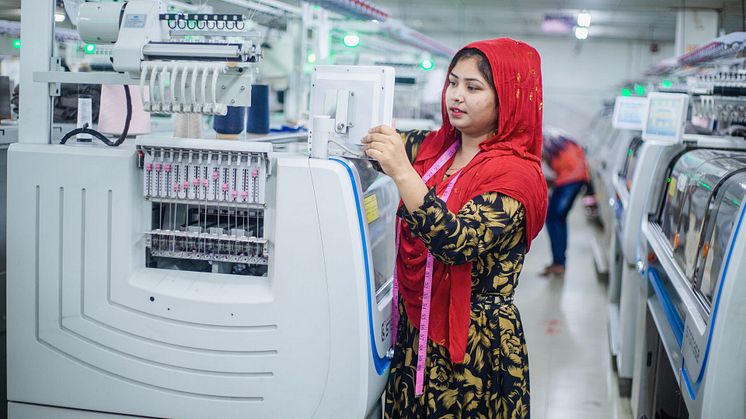
Bangladesh’s ready-made garment industry employs more than four million people and is central to the country’s economy. Women garment workers are the backbone of the RMG sector. Yet they’re also the most exposed to job loss, low wages, poor working conditions, and climate-related risks like heat stress and water insecurity.
The Oporajita initiative, launched by the H&M Foundation and implemented by a multitute of local partners, works to ensure a just transition in Bangladesh exactly for these women. The project provides access to future-ready skills, leadership training, gender-sensitive services, childcare, improved water and sanitation, and much more, equipping women garment workers to shape their own futures in an evolving industry.

By placing women’s voices at the core of programme design, Oporajita goes beyond the factory floor. It nurtures agency and confidence, addresses personal as well as professional needs, and turns potential job losses into pathways for leadership and resilience.
Here, inclusive circularity means ensuring that the shift to more efficient, low-carbon production systems uplifts rather than excludes those who power them.
Panipat, India: inclusion at the end of the loop
At the other end of fashion’s life cycle lies Panipat, a city in northern India known as one of the world’s largest textile-recycling hubs. Here, mountains of used garments arrive to be shredded, respun and rewoven. Yet despite its environmental importance, Panipat’s recycling ecosystem has long faced social and environmental risks.

The H&M Foundation is exploring ways to strengthen Panipat’s recycling ecosystem by engaging with local actors to design solutions that can improve safety, efficiency and fairness in a city where the stakes are high for both people and planet. The ambition is to build collaboration and local capacity so that textile recycling can become not only a climate solution but also a source of decent livelihoods for the communities that sustain it.
In Panipat, inclusive circularity means closing the loop in a way that creates prosperity, not precarity.
From projects to principle
These three initiatives span different points along the textile value chain, yet they share a common thread-ach combines environmental ambition with social inclusion, tackling root causes of inequality while enabling circular systems to grow stronger.
Together, they illustrate what a systems-change approach can achieve. Saamuhika Shakti reimagines waste as value and builds inclusion along circular value chains. Oporajita supports the green transition within production and redefines the the talent that will drive the industry forward. Panipat reclaims the end of fashion’s life cycle as a new beginning.
For us, inclusive circularity is not a project or a phase; it is a way of working. It isn’t just a better version of circularity – it's a shift in how the system is built, starting from the ground up. It connects innovation, research, collaboration and storytelling into one mission: supporting the textile industry in halving its greenhouse gas emissions every decade while promoting a just transition for everyone involved.
If we want circularity to stick, we must shape it with people at its centre. Include not only consumers, but also informal workers, factory workers and local communities in the design of circular solutions from the very beginning – that’s how circularity becomes a real force for the prosperous and equitable world we want to see. If you share this vision, let’s work together to build a textile industry that’s not only circular, but inclusive by design.