Press release —
Is the textile industry ready for 2040?
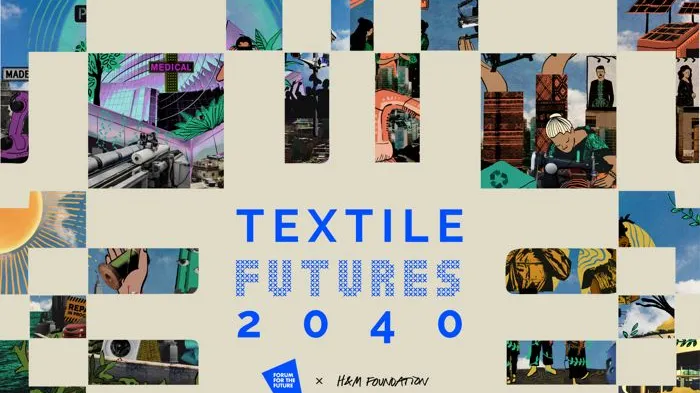
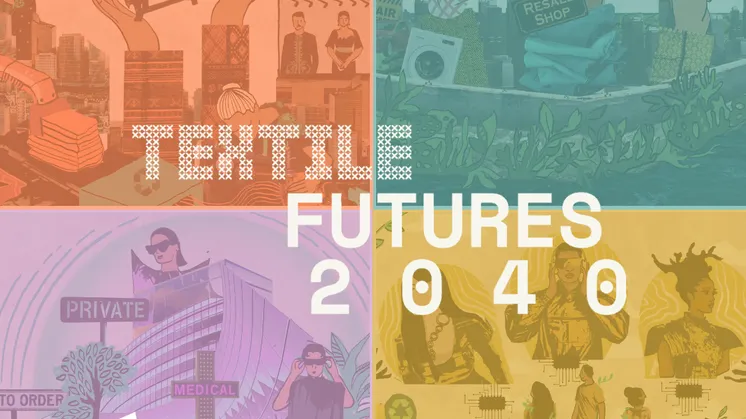
- Forum for the Future and non-profit H&M Foundation today launch Textile Futures 2040, four scenarios in which the textile industry of 2040 is shaped by forces as different as corporate consolidation, the rise of emerging markets, local repair economies and AI-led decision-making.
- Grounded in trends and signals already visible today, the scenarios challenge the industry’s dominant assumptions about growth, technology, consumption and responsibility, and differ in how supply chains work, from deeply interconnected to hyperlocal.
- The scenarios offer industry leaders a practical tool to test their strategies against different possible futures and make better-informed decisions towards a just transition to climate objectives like net zero.
The textile industry is a major global employer, accounting for around one in eight workers worldwide¹, companies across its value chain are increasingly committing to climate action: 88 percent of brands reporting to Textile Exchange now have formal targets². That transition, for the climate, for nature and for the people across its value chain, will take place in a changing world, as new technologies and business models emerge and economic conditions, geopolitics, regulation and social expectations shift.
This is where foresight can help. Exploring several plausible futures, rather than planning for one, allows organisations to challenge their assumptions and identify risks and opportunities early. Textile Futures 2040 puts this into practice through four scenarios for the industry in 2040, each the result of different developments and choices along the way. It builds on Forum for the Future’s earlier fashion scenarios, beginning with Fashion Futures 2030 in 2010.
"These scenarios test some of the industry’s most common assumptions, from continued growth to technology resolving the hardest problems. In one, supply chains remain global and highly consolidated, while in another production becomes largely local. Exploring futures like these shows how the same decision can lead to very different outcomes and helps organisations shape the future they want. They also point to the value of a just and regenerative transition, one that plans for livelihoods and nature alongside emissions and is built into decisions on materials, sourcing and investment from the outset."
Zoe Le Grand, Managing Director, UK and Europe, Forum for the Future
The scenarios in short
Each scenario includes a day in the life of someone living in it and a textile artefact from that future, drawn from speculative design to make each world tangible.
New Age Corporate Empire:Corporations become more powerful than governments, manufacturers gain influence and technology delivers efficiency, but inequality grows and decarbonisation remains secondary to profit. Everyday clothing becomes durable and climate-adaptive, while style moves into digital layers.
Power Shift: The centre of economic and cultural gravity moves towards Asia, where state-backed innovation, stronger labour conditions and booming consumption reshape the textile industry. Handmade craft gains value, and shoppers can trace who made each garment.
Global Storms, Local Shields:Global supply chains break under climate and resource pressures, making local production, repair and reuse essential to increasingly self-sufficient communities. The circular economy becomes the biggest source of growth, and repairers are highly sought after.
The New Noosphere: AI helps drive rapid decarbonisation and restore nature, but algorithms increasingly decide what gets produced, how resources are used and how people live. Recycled fibres become the main input, and some clothes can be planted.
The scenarios draw on expert interviews, focus groups and scenario-testing workshops with more than 60 stakeholders, from global and local brands, manufacturers, unions and labour rights advocates to futurists, designers, foundations, academics and students. Bhajinder Kaur, Founder of purpose-driven luxury womenswear Wolf & Byrd gained the following insight from these sessions, "A more sustainable and resilient fashion and textile industry cannot be built by individual businesses working in isolation. By exploring possible futures together, we can identify opportunities, challenge existing practices, and develop more thoughtful solutions that benefit both people and the planet."
An openly available toolkit of workshop materials lets organisations run their own sessions and test current strategies, investments and decisions against each scenario. Forum for the Future and H&M Foundation encourage organisations across the textile value chain to use the scenarios to explore how the future might play out and make decisions that are robust for any future.
“None of us knows what the textile industry will look like in 2040, but decisions made today will help shape it. We supported Textile Futures 2040 to help industry actors challenge assumptions and make better-informed choices on the path to net zero.”
Anna Gedda, CEO H&M Foundation
Related links
Topics
About Forum for the Future
Forum for the Future is a leading international sustainability organisation. For 30 years we’ve been convening change-making collaborations in partnership with business, governments, philanthropy and civil society to accelerate the shift towards a just and regenerative future in which both people and the planet thrive.
About H&M Foundation
H&M Foundation exists to support the textile industry in reaching net-zero by 2050, while promoting a just transition for both people and the planet. Funded by the Persson family, the H&M Foundation leverages its philanthropic strengths to drive transformative change, focusing on the areas of the textile value chain with the greatest potential for emissions reductions. Learn more at hmfoundation.com.