Press release —
Lufthansa Cargo has launched its summer flight schedule 2026
- Lufthansa Group network strengthens flexible transport options with belly capacity
- Supporting global supply chains with own freighter fleet
- Six European hubs reinforce one of the densest cargo networks in Europe
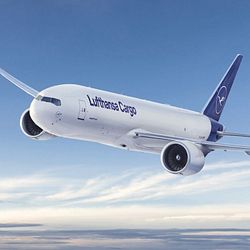
Lufthansa Cargo's new summer flight schedule came into effect last weekend. The company continues to focus on flexible and reliable transport solutions for its customers, which can also be steered according to shifting demand flows or global developments on short notice. This is based on its own long-haul freighter fleet of 18 B777Fs, which operates worldwide. In the coming months, a total of 87 flights per week to up to 35 destinations worldwide are available for Lufthansa Cargo customers. The importance of the Asian economic area is reflected in up to 48 weekly connections to 17destinations. The transpacific route from Ho Chi Minh City via Shanghai to Los Angeles will be increased by one more frequency to two rotations per week in the coming flight schedule period. Lufthansa Cargo is currently the only carrier that can offer its customers main deck capacity on the route from Vietnam to China. Starting in May, Delhi will be reintroduced into the freighter network with one weekly connection in order to better serve the important Indian market with six connections per week. The American market will be connected to Frankfurt with 33 connections per week and eleven destinations in North America and four destinations in South America. This will also include an increase by one additional frequency to Toronto (YYZ).
The four short- and medium-haul A321F freighters have also been serving Rome (FCO) and Algiers (ALG) once a week since February. This results in 33 connections within Europe and to Africa in the summer flight schedule, enabling fast transport connections via the hubs in Frankfurt and Munich. In the near future, Lufthansa Cargo will offer its customers flexible and reliable transport options via six hubs within Europe: Frankfurt, Munich, Vienna, Brussels, Rome, and soon Zurich. This is made possible by the enhanced cooperation with SWISS WorldCargo. Additional synergies in key commercial and operational areas enable a harmonized product and service portfolio. Customers of both companies will thus have access to one of the most comprehensive networks in the industry.
Lufthansa Cargo customers also benefit from the dense European network through the belly capacity offered within Lufthansa Group. With the new summer flight schedule, Lufthansa City Airlines has now been added to the belly portfolio. The expanded network of Lufthansa Group’s newest airline enables a quicker response to changing booking situations and supports flexible and reliable transport options via the hubs Frankfurt and Munich. Furthermore, several long-haul connections operated by Lufthansa Airlines from Frankfurt will be expanded in the summer: these include five weekly flights to St. Louis and Cape Town, six weekly flights to Rio de Janeiro and Raleigh/Durham, and daily flights to Nairobi. Washington will even be served by two connections per day, and Minneapolis will once again be served three times a week from April. Munich will continue to be connected to São Paulo and Johannesburg with three flights per week. ITA Airways is returning with two daily connections to London Heathrow, connecting the UK with the newest hub in Rome. From June, Brussels Airlines will add two flights per week to Kilimanjaro International Airport and increase its connections to Freetown to six per week. Discover Airlines is also strengthening its long-haul offering, launching year-round service to the Seychelles and increasing flights to Las Vegas to five per week. Austrian Airlines is also increasing its connections to the US with the resumption of daily flights to Los Angeles and a daily connection to Tokyo-Narita. Meanwhile, SunExpress is expanding its presence in the German and British markets with further frequency increases.
"Our soon-to-be six hubs in Europe enable one of the densest networks in our industry on the continent. Together with our own freighter fleet and the belly capacity within the Lufthansa Group, this not only means enormous flexibility for our customers, but also reliability and even faster transports of shipments. Lufthansa Cargo is already the home freight carrier in Germany, Switzerland, Italy, Belgium, and Austria. This enables further growth in the global air freight market in line with our mission of ‘Enabling Global Business’," explains Ashwin Bhat, CEO of Lufthansa Cargo.
The 2026 summer flight schedule has been effective since 29 March 2026. In addition to its own freighter services, Lufthansa Cargo also markets the belly capacity of up to 7,500 weekly flights to over 350 destinations operated by Lufthansa Airlines, Austrian Airlines, Brussels Airlines, Discover Airlines, ITA Airways, Lufthansa City Airlines, and SunExpress.
Topics
Lufthansa Cargo
Lufthansa Cargo is one of the world's leading cargo airlines and part of the Lufthansa Group, Europe's largest airline group. Through its five cargo hubs in Frankfurt, Munich, Brussels, Vienna and Rome, the airfreight specialist transports an average of 2,500 tons of freight per day. This is based on a strong and reliable airport-to-airport network that covers some 350 destinations in more than 100 countries. Lufthansa Cargo markets the cargo capacities of the passenger aircraft of Lufthansa Airlines, Austrian Airlines, Brussels Airlines, Discover Airlines, ITA Airways, Lufthansa City Airlines and SunExpress, as well as its own freighter fleet of 18 Boeing 777F and four Airbus A321F. In addition, some 300 trucks operate daily under a Lufthansa Cargo flight number. Together with its subsidiaries, Lufthansa Cargo offers customized, fast and efficient logistics solutions along the entire supply chain. In this way, the company fulfills its mission "Enabling Global Business" and connects markets and trading partners worldwide. Innovative technologies and investments in sustainability play a central role. In addition to a modern fleet and the use of sustainable aviation fuel (SAF), the focus is on continuous optimization of flight operations. In 2025, the company generated revenues of 3.40 billion euros and a transport performance of 9.10 billion freight tonne-kilometers. It currently employs approximately 4,300 people worldwide.