Gå videre til innhold
Deployment of the Teledyne Slocum glider G3 rigged with the eDNA sampler into a test tank (Photo: Akvaplan-niva)

Nyhet

Autonomous Gliders in the Quest for Ocean Biodiversity - the eDepthNA project

Environmental DNA (eDNA) refers to genetic material shed by organisms into their surroundings, such as water, through skin, faeces, mucus, or blood. It enables scientists to detect species and assess biodiversity without the need to capture organisms directly.

Typically, in marine pelagic systems eDNA is collected by filtering water samples. In most cases, this requires researchers to travel to sampling sites and filter water using manual or electric pumps. As a result, in addition to time consuming filtering, offshore biodiversity assessments depend heavily on vessel availability and are often expensive.

To address these limitations, TotalEnergies OneTech through their project OWESOME (Offshore Wind Environmental Survey Optimization to Monitor impacts on Ecosystems) funded the integration of an eDNA sampler manufactured by Dartmouth Ocean Technologies into a Slocum G3 glider, fabricated by Teledyne, to enable of collecting eDNA remotely across offshore environments and at varying depths. The glider was deployed in 2025 in the North Sea and a second deployment will take place in 2027. Following the OWESOME project development, Equinor and TotalEnergies One Tech joined forces to fund the eDepthNA project, which aims to further develop and validate an uncrewed autonomous vehicle.

The eDepthNA project is led by Akvaplan-niva in collaboration with the Norwegian Institute for Water Research (NIVA). Its objective is to integrate an automated eDNA sampling system into an underwater glider, enabling remote collection of eDNA throughout the water column. The sampler is being developed by Dartmouth Ocean Technologies, and the chosen platform is a Teledyne Slocum G3 glider.

In spring 2026, scientists conducted experimental work at Akvaplan-niva research station outside Tromsø, testing the sampler with known eDNA samples to optimize performance and ensure scientific validation. A fully validated system is expected to be ready by the end of 2026.

Picture 1: The eDepthNA research team and customer representatives. From left to right: Marc Angles D'Auriac (NIVA), Ehsan Abdi (Akvaplan-niva), Anders Hermansen and Anita Skarstad (Equinor) and Elizaveta Ershova-Menze (Akvaplan-niva).

Picture 2: selected organisms of well-known DNA

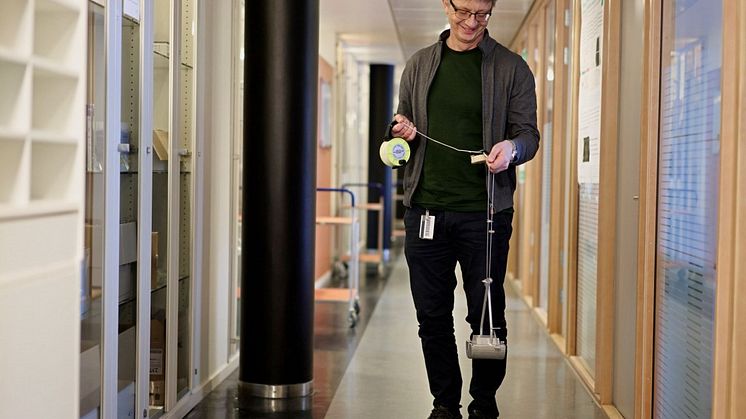
Picture 3: Handheld deployment of the eDNA sampler from Dartmouth Ocean Technologies into a laboratory tank (Photo: Akvaplan-niva)

Emner

Regions

Kontakter

Relatert innhold

  • eDNA metode for sanntidsovervåking av perlesnormanet

    Tidlig varsling av biologiske trusler er en økende utfordring for havbruksnæringen. De siste årene har økte observasjoner av Apolemia spp., kolonidannende sifonoforer ofte omtalt som trådmaneter, skapt bekymring på grunn av deres potensial til å forårsake alvorlig skade på oppdrettslaks. Disse organismene kan opptre plutselig og i store ansamlinger, noe som gjør rask deteksjon avgjørende for effek

  • Advancing Real-Time eDNA Monitoring of Toxic Jellyfish

    Early detection of biological threats is a growing challenge for the aquaculture industry. In recent years, increased observations of Apolemia spp., colonial siphonophores commonly referred to as string jellyfish, have raised concern due to their potential to cause serious harm to farmed salmon. These organisms can occur suddenly and in large aggregations, making timely detection essential for eff

  • Miljø DNA - en månelanding innen miljøovervåking

    Hvert år brukes millioner av kroner på å overvåke og kartlegge norsk natur for å kartlegge ulike parasitter i vannmiljø, for eksempel Gyrodactylus salaris. For en mer ressurs-effektiv kartlegging ble det for tre år siden igangsatt et arbeide for å utvikle en løsning for automatisk miljøovervåking ved hjelp av miljø-DNA. Nå i oktober demonstrertede to gjenværende konsortiene i den såkalte før-komme

  • Bakterie-DNA fra havbunnen skal vise om fiskeoppdrett påvirker miljøet

    Fiskeoppdrett, og etter hvert også oppdrett av skalldyr og dyrking av alger, er viktige næringer for norsk økonomi. Nå skal bakterie-DNA fra miljøprøver gjøre det enklere og raskere å måle miljøpåvirkning fra akvakulturnæringen i vann og sediment.
    Se for deg en person som sitter med lupe over en miljøprøve hentet fra bunnen av et vann, og som identifiserer og teller antall bunndyr som finnes i