Pressemelding —
MARGUERITE HUMEAU UNVEILS THE GARDEN OF RESUSCITATION AT KISTEFOS
Deep in the Norwegian woods, Turner Prize-nominated French artist Marguerite Humeau has created one of her most ambitious works to date: a living, evolving environment that unfolds across the forest at Kistefos, bringing together sculpture, ecology, ritual, and seasonal transformation.
Opening on 20 August 2026, The Garden of Resuscitation is the 60th work to enter the sculpture park. Conceived specifically for the site, the project transforms the surrounding forest itself into an artwork, incorporating plants and fungi, river currents, cultivated species, seasonal processes and annual rituals into the work itself.
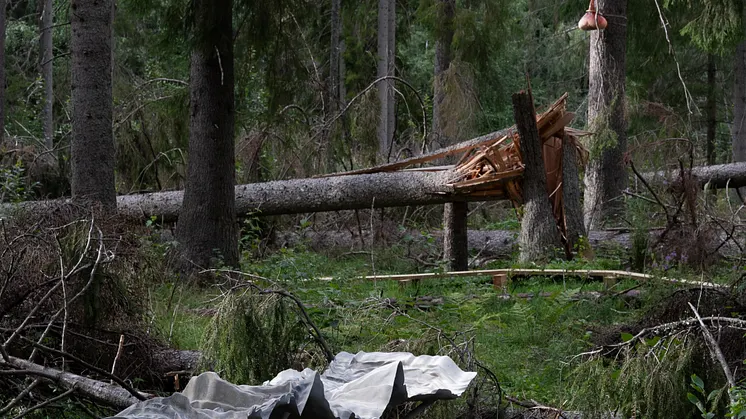
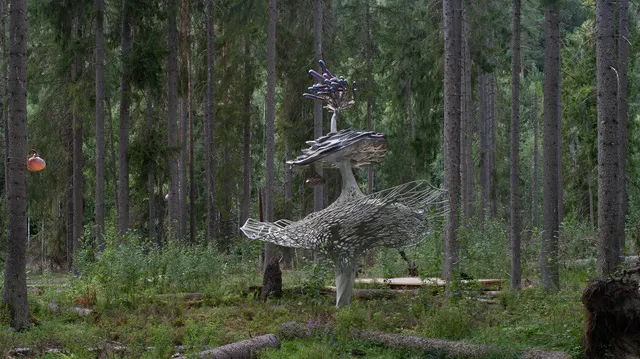
Situated in the southern forest zone along the Randselva river, the work is experienced as an immersive journey through the landscape, as visitors enter an unfolding environment through a garden cultivated as a recipe for an elixir, benches cast from paper-pulp that create places to pause within the work, and a boardwalk that takes us humans on a contemplative journey through the forest. At the heart of the project stands a monumental sculpture of a resuscitated spruce tree recomposed with elements of its parasitic and symbiotic species. Glass vessels containing the elixir made from the cultivated plants surrounding the artwork appear among the trees.
Other elements connect the artwork directly to Kistefos’ industrial history. Mounds of waste mulch from the neighboring paper factory sustain cultures of mushrooms, while plants and trees including fireweed, raspberry, yarrow, pine, spruce and birch are cultivated specifically for the production of the evolving elixir.
The elixir - the essence of the resuscitated tree - is central to the work’s life over time. Its recipe will continue to develop, using plants grown within the artwork, and the elixir will be prepared and shared during an annual communal gathering. The first will take place as part of the work’s inauguration on 20 August. Through repetition, memory and reinterpretation, both the recipe and the rituals surrounding it are intended to be transmitted across generations.
THE GARDEN OF RESUSCITATION
The Garden of Resuscitation (2026) is situated within the southern forest zone along the river at Kistefos. Conceived as a living and evolving environment, the work extends across the landscape itself, where ecological systems, sculptural forms, rituals and seasonal transformations become part of a single interconnected network.
Reconstructing the life of a spruce tree in reverse, the project follows what Humeau describes as a “journey from the dead” — transforming a former landscape of industrial extraction into a site of ecological reverence, regeneration, and ritual. The work traces a speculative cycle of renewal through roots, fungi, plants, river currents, and interdependent species, proposing an alternative understanding of the forest as a sentient, metabolising entity.
At the heart of the project stands a monumental sculpture of a resuscitated spruce tree recomposed with elements of its parasitic and symbiotic species. Sculptural and ecological interventions drawn from site-specific materials, forms, and ecological relationships, are presented throughout the site, including a boardwalk; benches cast from paper-pulp leaves; mounds of waste mulch – sourced at the nearby paper factory – sustaining mushroom cultures, as well as cultivated plants grown specifically for the production of a continually evolving elixir. Glass vessels containing this elixir and annual communal gatherings invite visitors to physically engage with and embody the rhythms of the forest itself.
The Garden of Resuscitation imagines decomposition not as an ending, but as a process of transformation through which new forms of life, rituals, stories, and mythologies can emerge. The evolving recipe for the elixir, together with the annual gatherings and rituals, is intended to be transmitted across generations — inevitably transformed through repetition, memory, and reinterpretation.
Known for creating speculative ecosystems that blur distinctions between myth, natural science, memory and the animate world, Humeau has developed The Garden of Resuscitation as an artwork that cannot be separated from the place in which it exists. Rather than remaining fixed, it will continue to grow, decompose and transform — shaped by the living systems of the forest and by the people who return to it.
ABOUT KISTEFOS
The arrival of The Garden of Resuscitation as the 60th work in the Kistefos Sculpture Park marks another chapter in the development of Kistefos as an international destination for contemporary art, architecture and industrial heritage.
Located on the grounds of a historic pulp mill north of Oslo, Kistefos brings these elements together within a landscape shaped by the Randselva river and the surrounding forest. The site’s industrial history began in 1889 with the establishment of A/S Kistefos Træsliberi, which produced wood pulp here until the mid-1950s. Kistefos in its current form was established in 1996 by Norwegian businessman and art collector Christen Sveaas, grandson of the mill’s founder, Anders Sveaas.
Today, Kistefos comprises an industrial museum, two art galleries and an expanding sculpture park featuring major site-specific commissions by leading international artists including Pierre Huyghe, Anish Kapoor, Claes Oldenburg & van Bruggen, Tony Cragg, Olafur Eliasson, Yayoi Kusama, Nairy Baghramian, Ida Ekblad and Dana Schutz.
Many of these works have been conceived in direct response to the landscape, industrial history and changing natural environment of Kistefos. With The Garden of Resuscitation, Humeau takes this relationship further, allowing the ecological systems and seasonal rhythms of the forest to become active participants in the work.
The award-winning gallery building The Twist, designed by BIG – Bjarke Ingels Group, spans 60 metres across the Randselva and functions simultaneously as museum, bridge and sculpture. Kistefos was named one of the world’s “must-see cultural destinations” by The New York Times in 2020.
ABOUT THE ARTIST
Marguerite Humeau (b. 1986, Cholet, France) lives and works in London. She received her MA from the Royal College of Art, London, in 2011.
Solo exhibitions of her work have been presented at HAM Helsinki Art Museum, Finland (2025); ARKEN Museum of Contemporary Art, Ishøj, Denmark (2025); ICA Miami, USA (2024); Lafayette Anticipations, Paris (2021); Kunstverein Hamburg, Germany (2019); Museion, Bolzano, Italy (2019); New Museum, New York (2018); Tate Britain, London (2017); Haus Konstruktiv, Zürich (2017); Schinkel Pavillon, Berlin (2017); Nottingham Contemporary, UK (2016); and Palais de Tokyo, Paris (2016).
Humeau’s work has been included in the 15th Gwangju Biennale (2024), the 59th International Art Exhibition of La Biennale di Venezia curated by Cecilia Alemani (2022), and the 23rd Biennale of Sydney (2022).
In 2023, Humeau realised the 160-acre earthwork Orisons in the San Luis Valley, Colorado, curated and produced by Black Cube Nomadic Art Museum — one of the largest earthworks ever created by a solo female artist. In 2026, she was nominated for the Turner Prize for her exhibition Torches, presented at ARKEN Museum of Contemporary Art before travelling to HAM Helsinki Art Museum (2025–26).
Emner
Kategorier
Kistefos was established in 1996 by the Norwegian businessman and art collector Christen Sveaas on the site of his grandfather’s former wood pulp mill. Today, Kistefos brings together art, architecture, and industrial heritage within an extensive sculpture park set in scenic natural surroundings. The institution presents annual exhibitions by leading national and international artists in its two galleries, The Twist and Nybruket Gallery. The award-winning building The Twist functions as a gallery, a bridge, and a sculptural landmark.
Kistefos continues to develop. A new visitor centre, designed by Lund Hagem Architects, will open in 2026 and include a café and museum shop. In 2031, a new museum building designed by Christ & Gantenbein is planned for completion. It will house both permanent and temporary exhibitions based on Christen Sveaas’ art collection.