Pressemelding —
For immediate release: Norway’s new National 22 July Memorial in Oslo to open 19 July
Public Art Norway (KORO) announces the completion of the National 22 July Memorial in the new Government Quarter in central Oslo, Norway.

The National 22 July Memorial, Matias Faldbakken's Upholding, under completion. © Matias Faldbakken / BONO. Photo: Niklas Hart / KORO.
Inauguration Sunday 19 July at 3 p.m.
The inauguration of the new 22 July Memorial, Upholding by Matias Faldbakken, will take place on Sunday, 19 July, 3:00–3:45 p.m., at Johan Nygaardsvolds plass, Oslo.
HRH Crown Prince Haakon will attend the inauguration.
The Minister of Digitalisation and Public Governance, Karianne Tung, opens the event. There will be music by ULD, speeches by the National Support Group after 22 July and the Workers' Youth League (AUF), and the artist Matias Faldbakken will engage in a conversation with survivors from the 22 July terror attack. Minister of Education, Kari Nessa Nordtun, will round off the event.
After the inauguration, KORO invites you to an open reception at Kunstneres Hus (the Artist’s House) in Wergelandsveien 17, Oslo. The program starts at 5 p.m. and includes a conversation between the artist and Trude Schjelderup Iversen (curator), film screening, music and refreshments.
Both events are free and open to all.
Background
The bombing in Oslo and the massacre on the island of Utøya on 22 July 2011 were the worst terrorist attacks in modern Norwegian history. The far-right nationalist killed eight people in the Government Quarter in central Oslo, and 69 people at the AUF (Workers’ Youth League) summer camp on the nearby island of Utøya.
In 2012, the government decided to establish two official memorial sites, one in connection with Utøya, the other in the Government Quarter in Oslo.
With his proposal titled Upholding, the Norwegian artist Matias Faldbakken won the international competition to design the national memorial site in the Government Quarter. The decision was announced on 8 April 2025, during a public event at Kunstnernes Hus (the Artists’ House) in Oslo.
- The memorial site will be a place to remember those who were killed during the terrorist attack, as well as the suffering inflicted on the bereaved, the survivors, and all others who were affected. It will become an important symbol that our democracy withstood even the gravest threat, said the Minister of Digitalisation and Public governance, Karianne Tung, at the event.

The National 22 July Memorial, Matias Faldbakken's Upholding, under completion. The motif on the mosaic depicts a small wader bird from the area around Utøya. © Matias Faldbakken / BONO. Photo: Niklas Hart / KORO.
Monumental and caring
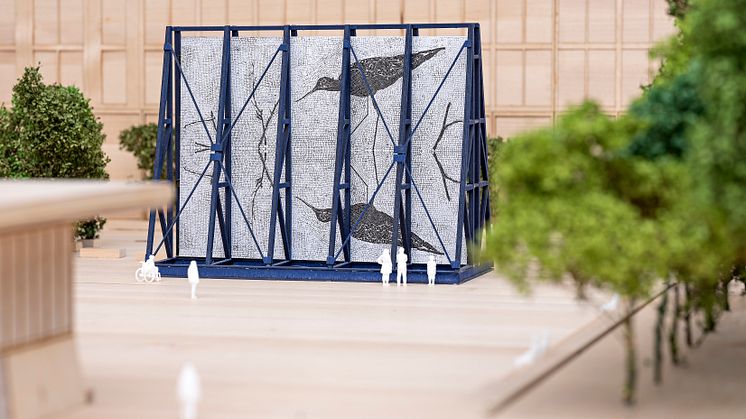
Faldbakken’s sculpture Upholding stands in the plaza vis á vis the iconic 1958 Highrise Building (H-Block) in the Government Quarter, as a monument framing the memorial site located between the H-Block’s Western Pavilion, and the entrance pavilion to the new 22 July Centre.
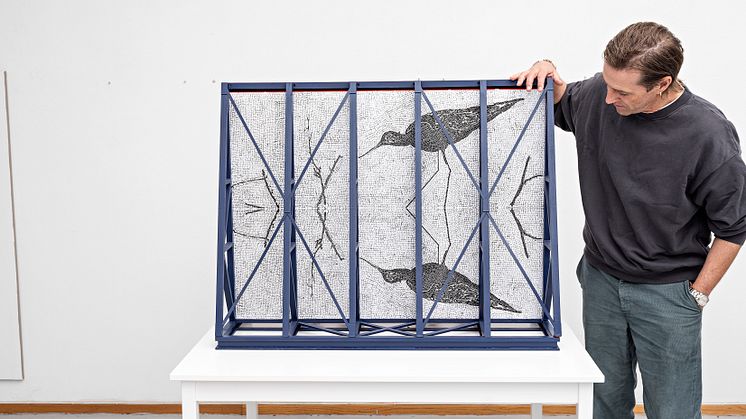
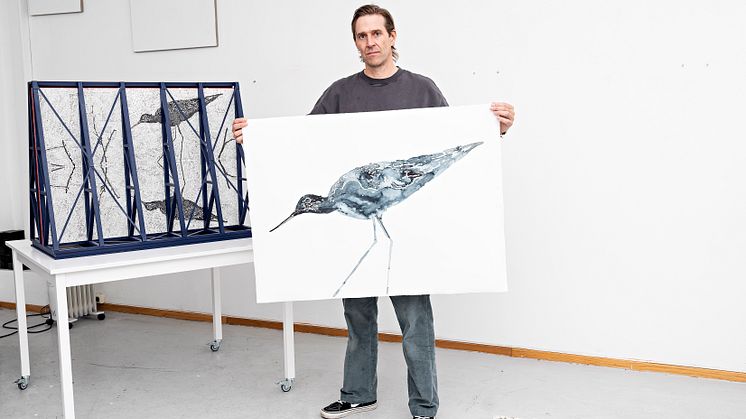
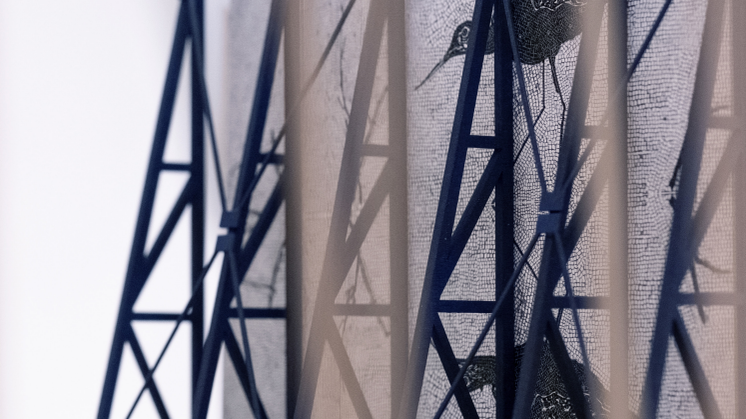
The sculpture Upholding is based on re-erecting the large steel rig that was built to hold and relocate Pablo Picasso’s artwork The Fishermen from the demolished Y-block to the new A-block, a result of the Quarter’s comprehensive reconfiguration in the aftermath of the bombing. In Faldbakken’s version, the rig is filled with a monumental mosaic comprised of around 300 000 stone pieces. The motif, taken from Utøya, depicts a small wader bird (a common greenshank) and some reeds and twigs reflected in the waters of the Tyrifjord.
The other side of the structure shows the pattern of the bracing frame, a geometric relief painted in deep blue, deep green, and vivid red. The colour scheme highlights the distinctive structure that supports the mosaic. The rig and the mosaic act as a link between the two scenes of the terrorist attack, the Government Quarter and Utøya.
- My motivation has been to create a work of art for those who were killed that day, Faldbakken says.
- At the same time, the work will embody much of the conflicted national history that followed the terror attack. The sculpture is meant to be experienced as large and insistent — brutal even — and its enormous weight must reflect the weight this tragedy has had in Norway. The mosaic, for its part, is a big artisanal investment, with tactile qualities and an imagery that alludes to lives that are small, exposed and irreplaceable.
As part of the work on the national memorial, the artist initiated a collaborative process to finalize the mosaic image. Together with the 22 July Centre and KORO, Faldbakken invited survivors, the bereaved, teenagers and members of the public to lay stones in the memorial mosaic together with Faldbakken. For a duration of three weeks around 2,000 people contributed to the work of adding the last 7,000 stones in a provisional workshop at the new memorial site. The final stone was laid by Merete Stamneshagen, chair of The National Support Group after July 22, whose daughter was killed at Utøya. The collaborative work marked the end of a long process that has involved many participants.

Chair of the National Support Group after July 22, Merete Stamneshagen, whose daughter was killed at Utøya, lays the last stone in the memorial mosaic. Photo: Niklas Hart / KORO
A new memorial aesthetic
Faldbakken’s memorial distinguishes itself from a canonical memorial tradition that has shaped much of the commemorative art since the 1980s. By focusing on ongoing maintenance of democratic life and conditions that make democratic practice possible, Upholding challenges the idea of memorials as mainly sites for contemplating past tragedies and loss of lives. In addition to commemorating the people killed in the terror attack, Faldbakken seeks, with his memorial, to engage the public in democratic resilience against the right-wing ideology that inspired the terrorist.
The steel structure with its industrial, provisional appearance evokes the labour required to build, sustain, and uphold a democratic society. The bird conveys vitality, and its body has a clear sense of direction, yet it also embodies a delicate balance — a vulnerable life. With its steady gaze, the small wader stands as a silent witness to the political processes unfolding in its presence.
- A new aesthetic memorial form is presented in Johan Nygaardsvolds Square today. Faldbakken’s work suggests that a society’s ability to build the infrastructure for upholding democratic values targeted on 22 July, is inseparable from remembering those who were killed, says curator and jury member Trude Schjelderup Iversen from KORO.
- It was precisely the new and unfamiliar aesthetic memorial form of Faldbakken’s Upholding, the jury acknowledged when choosing him as the winner of the competition. The memorial’s force lies in making visible the fragile conditions under which democratic life is sustained.

The National 22 July Memorial, Matias Faldbakken's Upholding. This side of the structure shows the pattern of the bracing frame, a geometric relief painted in deep blue, deep green, and vivid red. © Matias Faldbakken / BONO. Photo: Niklas Hart / KORO.
The conclusion of an inclusive process
The memorial will open to the public on 19 July, a few days prior to the 15-year commemoration of the terrorist attacks.
The inauguration concludes a four-year-long process which included an international open call and a thorough competition in two rounds, as well as a series of public seminars.
Throughout this commission, KORO has worked towards an inclusive and participatory process, facilitating extensive involvement and dialogue with interested parties, allowing space for reactions and encouraging a robust public conversation. KOROs mandate included a particular responsibility for involving stakeholders such as the bereaved, survivors and those directly impacted, including the Norwegian support group after the July 22 attacks, the Norwegian Labour Party’s youth wing (AUF), ministries, ministry employees and neighbours.
- A press conference will be held in Norwegian on 22 June at 11.30 a.m. International press is welcome to talk to the artist and KORO after the conference.
- International press is also welcome to talk to the artist and KORO prior to the official opening ceremony on 19 July and /or the commemoration on 22 July.
- Interview requests can be directed to Nina Frang Høyum: nfh@koro.no, +47 48 03 48 52.
The memorial is situated in proximity to KORO’s newly completed public art project for the first phase of the Government Quarter’s reconstruction. More info can be found here
The terrorist attacks
On 22 July 2011, seventy-seven people were killed by a far-right Norwegian terrorist. At 3.25 p.m., the extremist detonated a bomb in front of the high-rise building in the Government Quarter, killing six employees and two passers-by. He then drove to the AUF (Workers’ Youth League) summer camp on Utøya in Hole municipality, where he shot and killed sixty-nine people, most of them still teenagers.
At both locations, many more were seriously injured. The human and material destruction was immense. The impact was felt throughout Norwegian society.
Oslo District Court ruled that the attack of 22 July was politically motivated and aimed at the AUF, the Labour Party, the Norwegian government, and our democratic institutions. The terrorist’s actions were driven by a deep contempt for religious and ethnic minorities in Norway.
The National 22 July Memorial has been erected in the Government Quarter to uphold the memory of those who were killed and maimed that day, as well as to reinforce democratic values of plurality in a rejection of the extremist views that motivated the attack. The 22 July Centre, a close neighbour to the memorial, is a national learning facility that disseminates knowledge about the attack and its consequences. The Memorial, the Centre, and Utøya are all central to Norway’s ongoing efforts to prevent similar attacks and to counter the ideology that inspires them.
Today, the AUF is back on Utøya and government employees have returned to their offices. For survivors, the bereaved, and others directly touched by the attack, the consequences will be lifelong.
About the artist
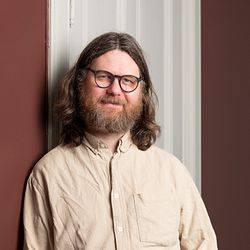
Matias Faldbakken (Norwegian, born 1973 in Hobro, Denmark) works as an artist and a writer in Oslo. He has exhibited at the Documenta 13 (2012) and represented Norway in the Nordic Pavillion at the Biennale di Venezia (2005). He has had solo exhibitions at WIELS, Brussels; Le Consortium, Dijon; Fridericianum, Kassel; Museum Boijmans van Beuningen, Rotterdam; The National Museum of Art, Design and Architecture, Oslo and The Astrup Fearnley Museum of Modern Art, Oslo. He has done large scale commissions for Norwegian Scenic Routes (Rondane), Parc de Tuileries in Paris, The Bass Museum, Miami and Hamar Rådhus.
Since 2001 Faldbakken has published six novels. As a writer he has won the Bjørnson Prize, the Norwegian Critic’s Prize, The Norwegian Radio’s Literary Award, The Oslo Price, The Dobloug Price and ITB Buch Award. He has been shortlisted for the Nordic Council Literature Prize and IMPAC—Dublin Literary Award. His six novels are translated into more than 18 languages.

Faldbakken with the model and sketch. © Matias Faldbakken / BONO. Photo: Vegard Kleven / KORO
Related links
Emner
Kategorier
Regions
Public Art Norway (KORO) is Norway’s national body responsible for curating, producing and activating art in public spaces. KORO manages an extensive collection of some 9.3000 artworks accessible at around 1.000 sites throughout Norway and abroad. In addition, KORO is a national center for research and knowledge development within the field of public art.