Press release —
When capital moves faster than capacity
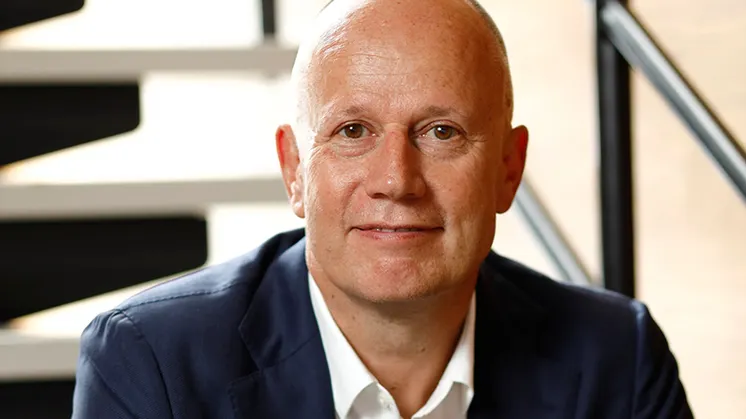
AI is exposing a growing gap between the speed of investment and the pace of grid connections. Peter Aarsen, President of Yanmar Energy Systems International, explains how decentralized energy can bridge it – and keep creating value long after the grid catches up.
A large data center can be built in as little as 12 months. Securing the grid connection to power it may take seven years. For Peter Aarsen, President of Yanmar Energy Systems International, that mismatch is familiar. What is new is how quickly it is becoming a boardroom problem.
Across two decades at Yanmar, Aarsen has moved from marine systems through European leadership to the decentralized energy business he leads today. That has kept him close to customers for whom reliable power cannot be taken for granted. An industrial business wants to expand and finds power unavailable; a telecom network reaches beyond a reliable grid. In a hospital, even a momentary interruption has immediate consequences.
“The question we increasingly hear is very practical,” he explains. “If I want to grow, do I have enough power available to do it? And if I don’t, how am I going to solve that?”
Artificial intelligence has taken that question into a different league, turning an energy challenge long familiar to other industries into a strategic concern for some of the world’s largest companies. “What AI is doing is making a much wider group of businesses think about energy earlier,” he says. “Once the investment can be ready years before the electricity, power starts influencing the investment decision itself – where you build, when you can begin operating, and how quickly the capital can start working.”
Two clocks running at different speeds
Independent data shows how wide that timing gap has become. The International Energy Agency (IEA) says grid connections across the European Union can take two to 10 years, while more than 2,500 GW of renewable generation, storage and large-load projects – including data centers – wait in queues worldwide.
The response is already visible. Great Britain’s National Energy System Operator (NESO) has reordered a queue exceeding 700 GW, prioritizing 283 GW of ready-to-build generation and storage alongside nearly 100 GW of new demand. In June, the US Federal Energy Regulatory Commission (FERC) ordered six regional operators to justify or reform connection rules for large new electrical loads.
Aarsen resists calling any of this a revolution. “I would rather say it’s an evolution,” he is quick to correct. “Generators have existed for decades, as have combined heat and power. Batteries have widened the options without changing the fundamentals. The technology is no longer novel. The real difference is that today, we can put a digital management layer over those assets and manage them as one integrated power plant.”
When waiting costs more than power
Businesses are increasingly finding ways around the delay. RaboResearch counts more than 130 GW of behind-the-meter energy resources proposed for planned US data centers, with gas generation accounting for more than 80%, partly because it can be deployed close to the construction timetable of the building it serves.
That electricity can cost more, roughly $100–165/MWh against $90–95 for grid alternatives; but unit price tells only part of the story. “There comes a point where the cheapest electricity is no longer the cheapest decision. If a very large investment is unable to operate, time becomes part of the economics.”
Speed may solve the immediate capacity problem; the longer-term value lies in adaptability. As more renewable energy becomes available, storage can capture excess supply, while digital management can coordinate generation, storage and demand and enable the system to support grid balancing as conditions change. A plant installed to bridge a five-year gap may still have decades of useful life ahead once the grid catches up. “If you buy an energy asset to solve a five-year problem, you should already be thinking about what you want it to do in year six.”
It is an engineer’s way of looking at a commercial problem. Aarsen trained in aeronautical engineering before moving into Mercedes-Benz truck service, where fuel efficiency translated directly into the cost of moving goods. He later led Yanmar’s marine business and Yanmar Europe before taking charge of Yanmar’s global Energy Systems business. Across those applications, the same instinct kept resurfacing – a determination to get more useful value from the energy and infrastructure already there.
Making the asset work harder
Industrial sites face a similar issue even without a grid delay. A factory’s energy system has to meet peak demand, even if that peak lasts only part of the production cycle, leaving costly capacity underused for much of the day. Energy is, in his words, an asset-heavy business, which is why those quiet hours interest him.
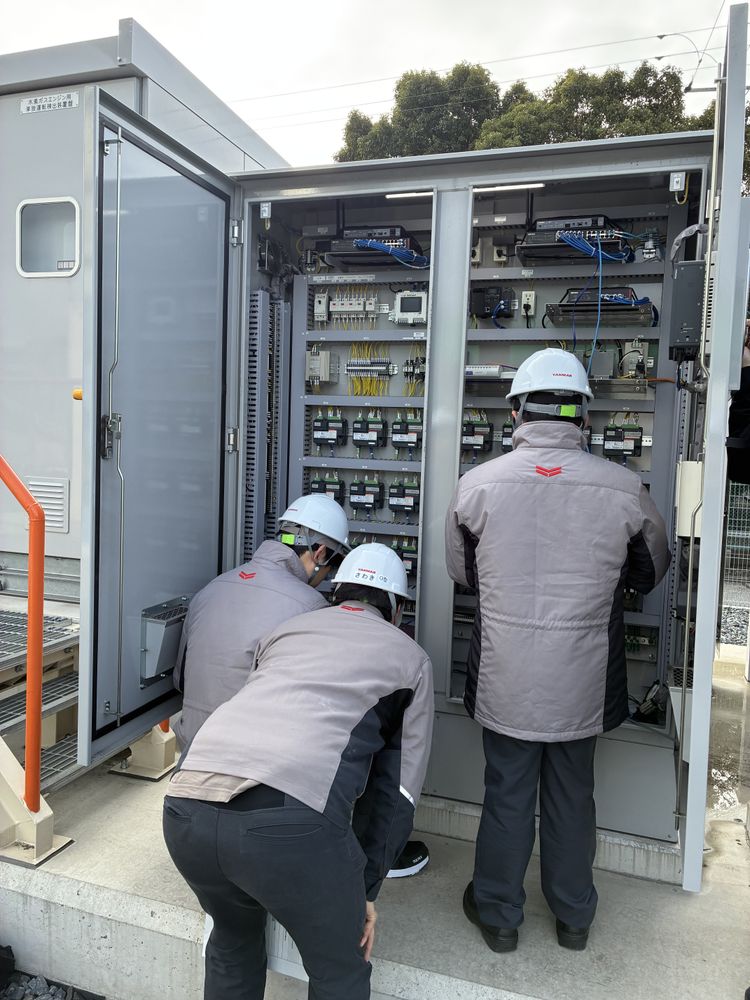
Yanmar’s Energy Management System, Y-EMS, is designed to make those hours useful. Across 18 installations, Y-EMS now covers an aggregate 4,009 kW of installed and/or managed capacity: 2,685 kW from gas-powered combined heat and power, 934 kW from solar photovoltaic systems and 390 kW from hydrogen-based combined heat and power and fuel cells. By coordinating these assets around the customer’s operating rhythm, the system can factor in energy prices, storage and, where market rules allow, opportunities to support the grid.
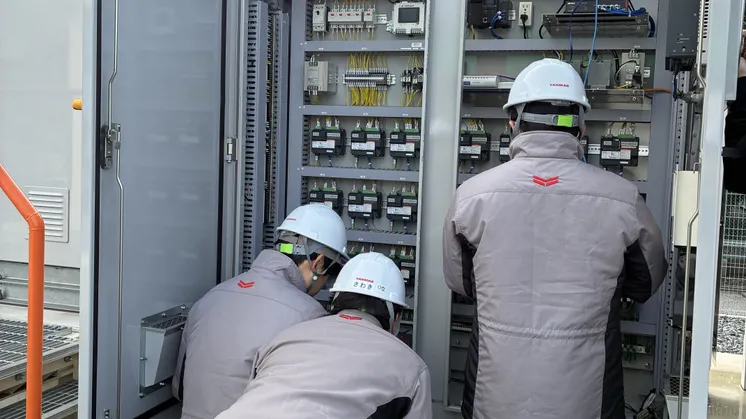
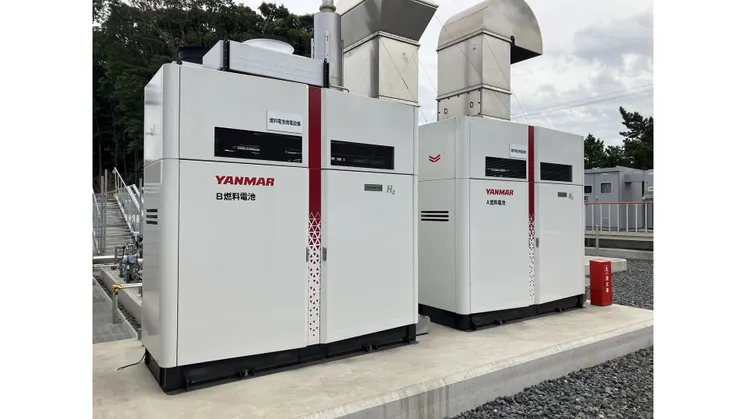
At JERA’s Sodegaura Thermal Power Station in Japan, Y‑EMS provides integrated monitoring and control for a 390 kW hydrogen power generation facility combining a 320 kW gas engine with two 35 kW fuel-cell units. Cloud integration automates the transfer of generation schedules, reducing manual intervention and the risk of error while helping the plant operate reliably according to plan.
Other installations demonstrate the financial value of optimization. At Marutai’s Fukuoka factory, Y‑EMS optimizes the use of waste heat from two CHP units for absorption cooling and air conditioning, producing annual cost savings of approximately ¥1 million.
“An idle asset still has capital tied up in it. Once the management system understands the customer’s operation and what is happening in the energy market around it, those idle hours can start to have value.”
That flexibility extends to fuel. For Aarsen, the energy transition does not necessarily make the internal combustion engine obsolete. It can also change what fuels it. In the Cayman Islands, where gas is unavailable, Yanmar is generating sets run on the Hydrotreated Vegetable Oil (HVO); elsewhere its systems use biogas. The engine can therefore outlive the fuel it was originally designed around, with any necessary modifications made as the energy system around it evolves.
The customer is not an energy trader
Greater sophistication should simplify life for the customer. Operators can see how assets are performing, but once management becomes complex, particularly where distributed resources interact with the wider network, algorithms can make many decisions automatically. “The customer should not have to become an energy trader. The intelligence should sit underneath the business. Whether they run a factory or a hospital, their job is elsewhere.”
Başakşehir Çam and Sakura City Hospital makes that tangible. One of Europe’s largest hospitals, the million-square-meter complex in Istanbul has 2,682 beds. Yanmar supplied a 12 MW trigeneration system that reuses waste heat across the hospital, including for cooling. Yanmar estimates the system can cut CO₂ emissions by around 60% compared with grid power and save €1.8 million a year in energy costs.
Those figures describe efficiency, yet his measure is more immediate. “The biggest headache for a hospital is that they can continue with the surgery when the grid fails. Backup power needs to be restored within one or two seconds. A hospital doesn’t really want an energy system; it wants the surgeon to be able to carry on operating. Once you start with what the customer truly needs, you think differently about everything underneath it.”
Making technology fit the place
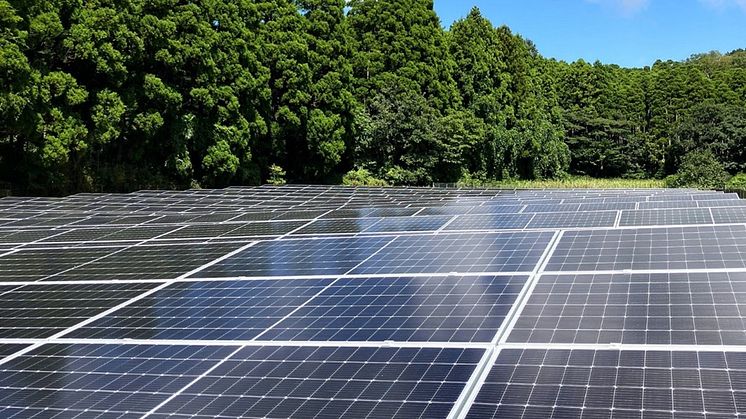
The same pragmatism shapes Yanmar’s evolution from manufacturer to solutions provider. “When I joined YESI, we were purely a product manufacturer.” Today, the starting point is the customer’s circumstances; in some projects Yanmar builds, owns and operates the plant, selling the energy it produces to the customer. Partnership is part of the model too. At telecom sites, Yanmar supplies the generating equipment and control system while specialists provide the solar panels.
“Technology can be developed centrally, but energy is always local. The grid behaves differently from market to market, as do the available fuels and economics. You have to make the solution work in that place.”
AI is beginning to sharpen that capability, though it remains a relatively small part of the platform. It can identify failures earlier, shift maintenance from fixed schedules towards actual equipment condition and anticipate grid imbalances. There is a clear irony here: AI is driving an enormous expansion in electricity demand, while a quieter application of the same technology may help determine how effectively the infrastructure built to serve it is used.
“The grid is a beautiful thing”
The growth of local generation might suggest businesses are moving away from the shared grid. Aarsen argues the opposite. “You always need a grid,” he says. “The grid is a beautiful thing.” It is a striking view from someone whose business generates power closer to where it is used.
Its value lies in connecting users and resources; distributed energy can complement it by easing pressure where capacity is tight and responding when conditions change. What those assets add, in Aarsen’s phrase, is “the speed of flexibility”. Large centralized plants remain fundamental, but many cannot change output as quickly as smaller resources coordinated digitally. That matters more as renewable generation grows and output varies through the day.
Asked whether abundant renewable electricity might make decentralized energy less necessary, the answer comes in two words. “No. More.” His reasoning is equally direct. “The more renewables are coming into the picture, the more we need the decentralized resources to balance everything as a whole.”
Businesses are investing in local generation because their growth cannot always wait for the grid. Those assets, he argues, should remain valuable long after the wait is over. “The first question is whether you can get the power you need in time. The more interesting question is what that asset can become once the reason you bought it has changed.”
Topics
Note: Information contained in the news release is valid at the time of publication and may differ from the most recently available information.
[Inquiries for further information]
Corporate Communications, Yanmar