Press release —
New data from Discovery Green reveals how South African business electricity demand changes in December
December electricity demand among businesses analysed ranged from 27% below to 91% above their individual annual averages, while blended demand across Discovery Green’s EnergyOS-integrated portfolio moved by 2.7%, with EnergyOS allocating energy across the year so that clients with volatile demand don’t pay for energy they don’t use. This accounts for Discovery Green clients and does not necessary reflect overall national demand, which drops by roughly 15%.
Key findings from Discovery Green’s analysis
- December electricity demand among the businesses analysed ranged from 27% below to 91% above each client’s own annual average.
- Businesses in the same sector did not necessarily follow the same festive-season consumption pattern.
- Across Discovery Green’s EnergyOS-integrated portfolio, blended December demand moved by 2.7%.
- EnergyOS allocates energy smartly over the course of the year, so customers with volatile consumption never pay for energy they don’t consume, while still replacing 90% of their consumption.
How does business electricity demand change over December in South Africa?
Discovery Green’s analysis gained through EnergyOS, its energy data and forecasting platform, shows that there is no single festive-season electricity-demand pattern among the businesses analysed. Some businesses used materially less electricity in December than their annual average, while others used more. The range extended from 27% below to 91% above individual clients’ annual averages.
The analysis draws on 12 months of 30-minute electricity-consumption data across Discovery Green clients. The results show why assumptions such as “business slows down in December” can obscure substantial differences between individual operations.
Andre Nepgen, CEO of Discovery Green says, "Most businesses assume renewable energy planning is about buying enough coverage. Our data shows the real risk isn't coverage, but volatility. No two businesses slow down or ramp up the same way over the festive season."
Nepgen explains, "EnergyOS analyses the consumption patterns and allocates energy over the course of the year so that customers who are volatile in their consumption never pay for energy they don't consume whilst replacing 90% of their consumption. Its model constantly adapts and learns to ensure that the client's risks are minimised, even in scenarios where consumption changes are unexpected."
What is electricity-demand volatility?
Electricity-demand volatility refers to changes in how much electricity a business consumes over time. Discovery Green’s analysis illustrates that these changes can differ materially between businesses, including businesses operating in the same sector. That makes business-specific consumption data relevant when planning renewable electricity procurement.
December demand swings by more than 90%
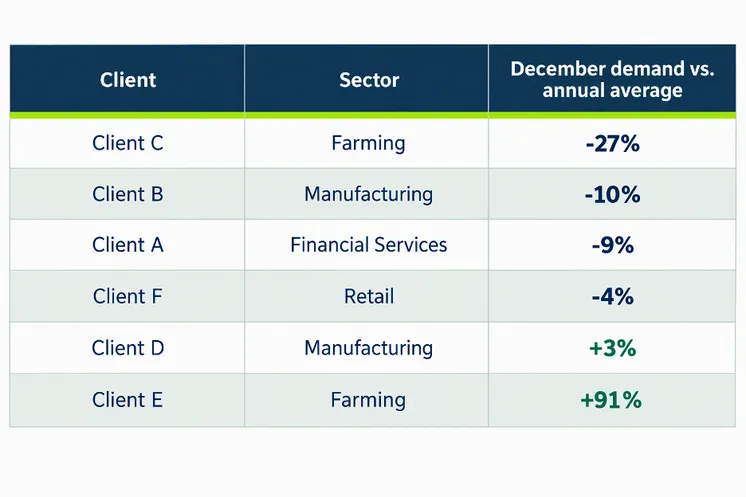
In its analysis, Discovery Green found there was no single energy consumption trend, even for company’s in the same industry. For instance, two farming operations moved in sharply different directions last December. One recorded demand 27% below its annual average, while another was 91% above. Similarly, for two different manufacturing businesses, demand also differed, at 10% below and 3% above their respective annual averages.
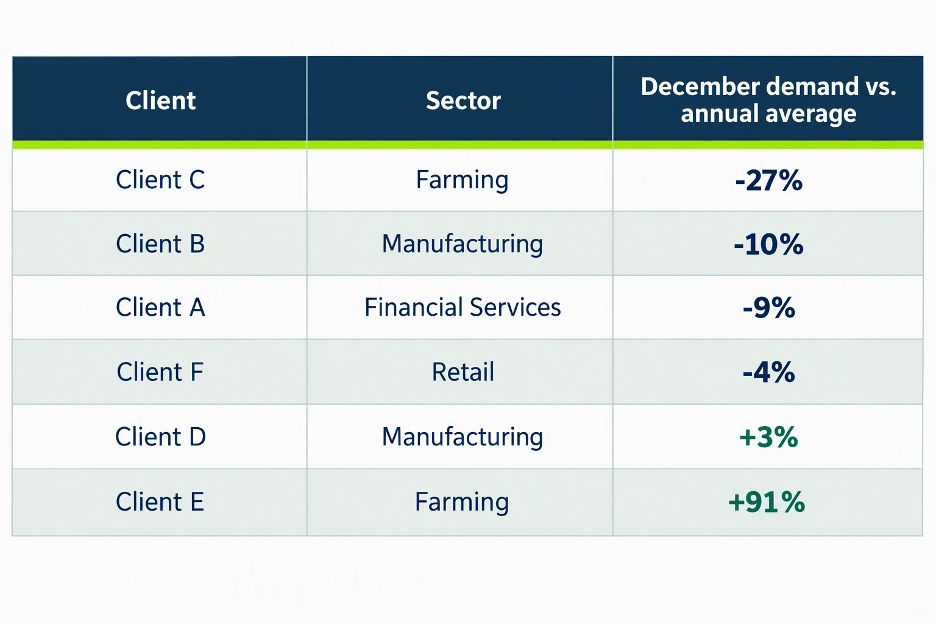
Source: Discovery Green analysis of 12 months of 30-minute EnergyOS consumption data.
In the farming example, operational factors such as irrigation cycles, shutdown schedules, holiday trading patterns and operational calendars all pull in different directions, can affect electricity demand. The analysis therefore supports looking at actual consumption patterns at business level rather than relying only on broad sector assumptions.
Nepgen adds, "This is the kind of pattern that only emerges when you measure consumption at a granular level. Rather than contracting each client to a fixed, individual supply profile, EnergyOS pools diversified consumption patterns across the entire client portfolio and continuously models hundreds of thousands of generation and consumption pathways to allocate renewable energy to where it will actually be used."
How portfolio diversification can stabilise electricity demand
In Discovery Green’s analysis, the combined portfolio was substantially more stable in December than individual business demand profiles. While individual clients ranged from 27% below to 91% above their own annual averages, blended demand across Discovery Green’s EnergyOS-integrated portfolio moved by 2.7%.
Within the portfolio analysed, businesses whose electricity demand increased in December helped offset businesses whose demand declined. Diverse client base allows different consumption patterns to balance one another across the portfolio.
How EnergyOS turns consumption data into smarter renewable energy decisions
Notably, this is only possible because the model is continuously learning. EnergyOS uses granular generation, consumption and market-pricing models and pooling diversified client consumption patterns to sharpen renewable-energy allocation and energy-risk management for its clients.
Implications for South African businesses
The practical lesson from the analysis is that renewable-energy planning should begin with the individual business’s actual electricity-consumption profile. Businesses in the same industry can behave differently, and seasonal demand can move in opposite directions. More granular data can therefore provide a clearer basis for understanding changing electricity needs.
Nepgen concludes, "Making the most of your renewable energy supply has to begin with specificity. The more data you have at your disposal, the more you can align your changing supply to your real-time renewable energy needs."
Topics
Categories
Discovery information
About Discovery
Discovery Limited is a South African-founded financial services organisation that operates in the healthcare, life assurance, short-term insurance, banking, savings and investment and wellness markets. Since inception in 1992, Discovery has been guided by a clear core purpose – to make people healthier and to enhance and protect their lives. This has manifested in its globally recognised Vitality Shared-Value insurance model, active in over 37 countriess with over 50 million members. The model is exported and scaled through the Global Vitality Network, an alliance of some of the largest insurers across key markets including AIA (Asia), Ping An (China), Sumitomo (Japan), John Hancock (US), Manulife (Canada) and Vitality Life & Health (UK, wholly owned). Discovery trades on the Johannesburg Securities Exchange as DSY.
Follow us on Twitter @Discovery_SA
About Discovery Green
Discovery Green helps large businesses substantially reduce energy costs, lock in long-term pricing, and transition to as much as 90% renewable energy coverage on average — without the operational risk. Underpinned by EnergyOS, its proprietary data and forecasting platform, Discovery Green combines over 30 years of actuarial expertise with granular generation, consumption and market-pricing models to actively price, manage and share energy risk with its clients, rather than simply passing it through.
Follow Discovery Green CEO, Andre Nepgen on LinkedIn.