Press release —
Electric Ferry Candela P-12 Awarded Sweden’s Most Iconic Design Prize, Utmärkt Svensk Form
Rethinking water transport meant rethinking what a ferry is. The result is the Candela P-12, the world’s first electric hydrofoil ferry.
Now, it has been awarded Sweden’s most prestigious design distinction, Utmärkt Svensk Form.
With the award, P-12 joins a long line of Swedish products that have left their mark on the world, from Volvo cars to IKEA furniture.
Candela P-12 is the world’s first high-speed, long-range electric ferry. Its computer-controlled hydrofoils lift the vessel above the water, cutting energy use by 80% while eliminating emissions and wake.
Now, an often overlooked aspect of P-12 - its design - is being recognised by Svensk Form, the world’s oldest design organisation, founded in 1845.
Rethinking what a ferry is
When designing the P-12, Candela started with a blank sheet of paper.
“The first stage was to completely free ourselves from what a ferry is supposed to look like and ask: what is the most efficient way of transporting people on water?” says Gustav Hasselskog, founder of Candela, who led the design team.
In cities around the world, roads are congested and commuting times long and unpredictable. Yet many cities have an underused resource: their waterways.
To unlock them for fast, convenient public transport, the design team had to rethink the conventional ferry. Traditional vessels consume large amounts of energy, produce emissions and, due to their large wakes, are often subject to speed restrictions. The result is infrequent service and long journey times.
This became the design brief for P-12: create a vessel that could make waterborne transport faster, cleaner, less costly and more frequent.
P-12 carries 30 passengers and is operated by one staff. Its hydrofoils allow it to travel at high speed while using a fraction of the energy of conventional vessels and creating almost no wake. Its smaller size means that instead of relying on a few large vessels, operators can deploy more units and offer frequent departures, creating a system that operates more like a bus network than a traditional ferry service.
The next stage of the design process, Hasselskog explains, was about Candela’s guiding principle. How could every part of the ferry be made more efficient, from energy consumption and charging to passenger flow? And how could an entirely new type of vessel fit seamlessly into the existing urban web of infrastructure?
“It’s about the hard engineering stuff, like removing every unnecessary kilogram and adapting to different quays and accessibility needs, while at the same time rethinking the experience. How can we create a much better journey?”
Bringing mass production to ferries
Current large diesel ferries are often built as one-offs and built close to their intended area of operation. To allow for industrial manufacturing and shipments around the globe - including to inland cities and lakes that cannot be reached by sea - the P-12 design team settled to stay inside a 4.5x4.5x12m box to make it transportable on roads. This also opens for manufacturing scale - and cost benefits - never seen before.
The goal was to achieve a long range, a high speed and low operational cost. That means, among other things, an extreme focus on keeping the weight down and hunting every single percent of hydrodynamic and drive train efficiency.
“I believe some of the greatest creativity comes from hard constraints, and P-12 is very much a product of that. Its beauty comes from its purpose: every line has a reason and every part is necessary. In this way, it follows the classic functionalist idea”, says Hasselskog.
Engineering the experience
Another guiding principle was that P-12’s advanced technology – needed to make it fly - should transform the passenger experience without demanding the passenger’s attention.
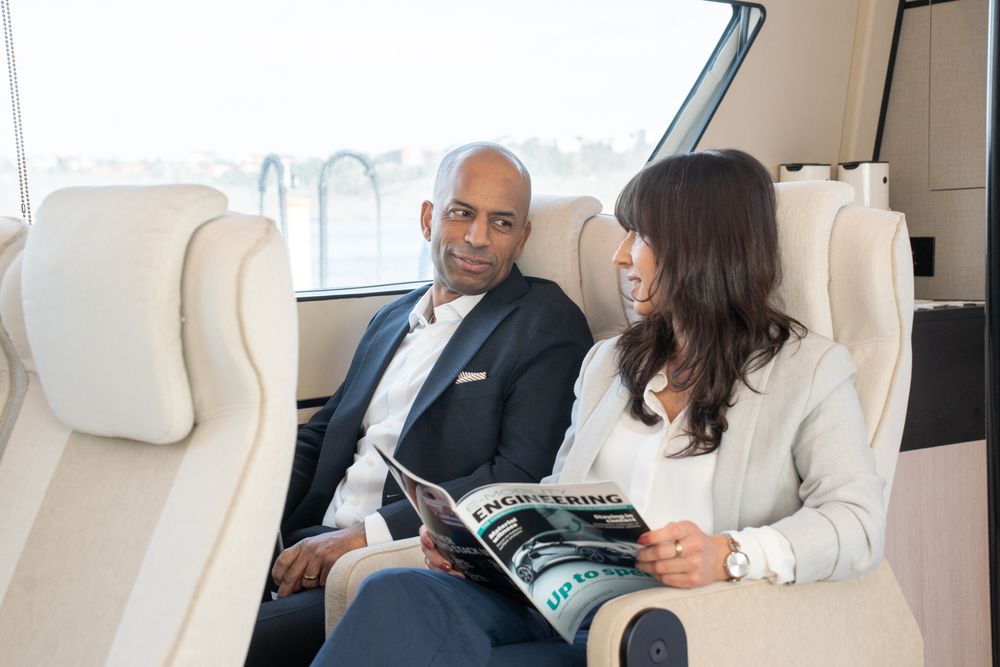
Thirty passengers sit in a bright cabin surrounded by large windows, giving panoramic views of the very thing that makes travelling by boat special: the water.
The cabin is remarkably quiet. P-12’s electric C-POD motors sit submerged beneath the surface and have no mechanical transmission, minimizing both noise and energy losses. When the vessel takes off, a computer controls the hydrofoils to keep the vessel stable above the waves.
The result is an experience that is largely created by software, but designed to feel natural. The Flight Controller works unnoticed in the background, leaving passengers with a calm, serene experience.
Fast deployment, avoiding a five-year infrastructure project
New ferry routes typically require new docks. Conventional electric ferries also need heavy-duty cables and dedicated charging infrastructure. Both are costly, complex and can take years to build.
P-12’s flexible, dampened bow ramp allows the vessel to quickly embark passengers at everything from low floating jetties to high concrete quays, while providing an accessible boarding angle for wheelchairs and strollers.
To avoid costly dedicated charging infrastructure, the P-12 uses standard automotive DC chargers. The technology is already widely available, keeping installation simple and costs low.
“With these two features, we can deploy at scale within weeks rather than in years”, says Hasselskog.
Shaped by efficiency
On conventional boats, hydrodynamic resistance dominates, making aerodynamic drag comparatively unimportant. Once P-12 rises above the surface, water resistance falls dramatically and aerodynamics becomes a much larger part of the equation. Its profile is therefore designed to be as efficient as possible, contributing to its long range.
“The elements – air drag and water drag – have shaped P-12 more than anything else. The streamlined silhouette is unmistakably Candela, but it is driven by function rather than styling. Every line is there for a reason”, explains Hasselskog.
And when P-12 flies past at 25 knots, perhaps its most distinctive design feature is what it leaves behind.
Just a thin white line across the water.
Jury motivation from Svensk Form:
“Through advanced hydrofoil technology, low energy consumption and a clear focus on the user, Candela P-12 is reshaping the possibilities for the future of waterborne transport. The project brings together Swedish design and engineering in a transport system where efficiency, accessibility and environmental sustainability work hand in hand.
Candela P-12 is awarded Utmärkt Svensk Form 2026 for demonstrating how innovation, sustainability and design can unlock new forms of climate-friendly mobility on water.”
About Svensk Form
Svensk Form was founded in 1845 and is the world’s oldest design organisation. For more than 180 years, the association has worked to develop, showcase and strengthen Swedish design, both in Sweden and internationally.
An important part of Svensk Form’s history has been the connection between design, industry and societal development – how design can contribute to improving products, businesses and people’s everyday lives.
This also creates a natural connection to the Candela P-12: a Swedish project where design, technology and engineering come together to rethink an established transport system.
About Utmärkt Svensk Form
Utmärkt Svensk Form was established in 1983 and is Svensk Form’s most prestigious distinction.
The award recognises some of the finest examples of Swedish design across products, materials and environments. It is not open for applications. Instead, Svensk Form and an independent jury conduct a broad review of the Swedish design landscape and select works considered to be of exceptional quality and to contribute to the development of Swedish design.
Recipients span fields including fashion, furniture, architecture, product design, games, visual communication and mobility.
Related links
Topics
Stockholm-based Candela Technology AB is the world leader in hydrofoiling electric vessels. The company was founded in 2014 by engineer and business leader Gustav Hasselskog with the mission to accelerate the world's transition to fossil fuel-free lakes and oceans by developing electric vessels that outperform those powered by fossil fuels.
Candela's watercraft have wings (hydrofoils) that lift the hull above the water and reduce friction, using 80% less energy than conventional ships at high speed. This technology allows for long-range water travel solely on battery power, a first in the industry. Candela's hydrofoils also enable operators to transition to sustainable fleets by providing up to 50% lower operational costs.
At the heart of Candela's hydrofoil tech stack is the Flight controller, which automatically stabilizes the vessel during flight by regulating the foils, using sensors that gauge wave height and wind speed, among other factors. Even in rough weather, passengers experience 90% less g-forces than they would on a traditional boat. All Candela vessels are fully connected and receive over-the-air updates.
After five years of research and development, Candela began producing the world's first electric hydrofoil leisure boat in 2019, the Candela C-7 open "roadster of the seas". This was followed in 2022 by the high-volume market Candela C-8, which was delivered to the first customers in spring 2023. Over 150 C-8 units have been sold to date, and the vessel has been lauded as a "game changer" by Motorboat and Yachting magazine, winning numerous awards including the 2022 European Powerboat of the Year award for its superior seakeeping, long range, and high speed.
In 2023, Candela launched its first commercial vessel, the Candela P-12 Shuttle ferry. It is the fastest and longest-range electric ship ever built, with a top speed of 30 knots and a range of 40 nautical miles at 25 knots. It is also the most energy-efficient fast ship ever made in its size class. Substantial operational cost savings are expected. The first unit enters service in Stockholm's public transport system in 2024.
Candela is a technology company with headquarters in Stockholm, Sweden, employing over 200 engineers, technicians, and production staff. The company develops the entire tech stack, from the C-POD motor to the control system and carbon fiber hulls, in-house. Candela's two wholly-owned factories in Stockholm, Sweden, produce the Candela C-8 and P-12 vessels. The company also has leisure boat resellers in 12 countries and wholly-owned sales offices in San Francisco, USA, and Cannes, France.