News —
DET Commissions LNG Terminal in Stade
With the commissioning of its fourth floating import terminal for liquefied natural gas (LNG), in Stade, Deutsche Energy Terminal GmbH (DET) has completed its mandate from the federal government: four terminals in four years. In addition to the new site, DET operates two LNG terminals in Wilhelmshaven and one in Brunsbüttel. This completes the construction of the four floating LNG import terminals commissioned by the federal government.
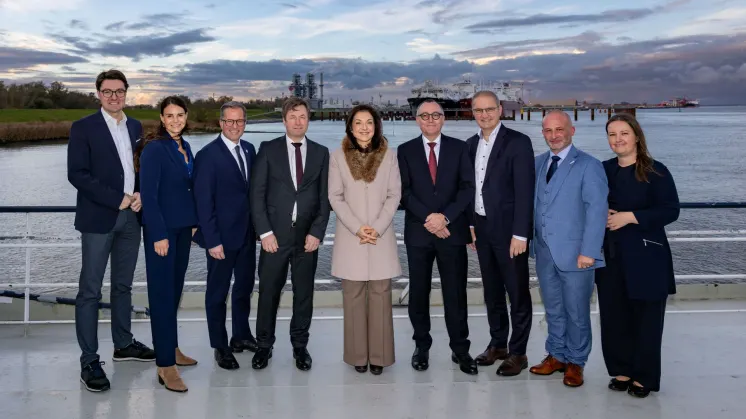
The terminals expand the options for importing natural gas independently of individual transport routes and supply structures. In doing so, they strengthen the security and resilience of Germany’s energy supply. At a press event marking the commissioning in Stade on 16 November, Federal Minister for Economic Affairs Katherina Reiche, Lower Saxony Minister-President Olaf Lies, and representatives from politics, industry and project management recognized the terminal’s significance.
Reiche described Stade as “the fourth and final federally owned terminal” and pointed to the pace of the build-out: “Four terminals in less than four years” showed how quickly Germany could act when necessary. The country’s gas supply now had a broader base and was less dependent on individual suppliers and transport routes. The Energos Force adds another import route, further strengthening supply this winter. In 2027, Stade is expected to feed up to 3.2 billion cubic metres of natural gas into the German gas grid. In mathematical terms, that is equivalent to the annual heating demand of around 2.6 million four-person households.
Olaf Lies also highlighted the site’s contribution to security of supply. Lower Saxony had taken responsibility during a challenging period and helped broaden the foundations of the energy supply. “Security of supply is a prerequisite for economic strength,” the Minister-President said. At the same time, infrastructure must provide security today and pave the way to a climate-neutral energy supply tomorrow. Stade is an important site for that effort.
For DET, commissioning the terminal marks the completion of an exceptional task. Delivering four floating LNG terminals within four years had been a “joint effort by many parties,” said Dr Peter Röttgen, CEO and spokesperson for the management board. During the acute emergency, planning, permitting and construction had to proceed at several locations at once. With Stade now operational, all four terminals are in service, supporting a secure and resilient energy supply for Germany.
DET thanked the companies, authorities and other partners involved in delivering the site. Niedersachsen Ports built the berth on schedule; Gasfin Development and Worley then completed the gas infrastructure. Further support and cooperation came from Gicon, Energos Infrastructure, Dow Deutschland, Gasunie Deutschland, Eiko, the Federal Ministry for Economic Affairs and Energy, and the authorities involved. The partners’ varied expertise and contributions were essential to delivering the project.
With the build-out phase complete, DET is turning its attention to the further marketing of regasification capacity and to reliable operations. According to the company, the experience gained from delivering the four terminals provides an important foundation for its future work. It shows how complex infrastructure projects that are new to the German market can be successfully delivered—even under exceptional conditions—by building the necessary expertise in a targeted way.
The FSRU Energos Force is 294 metres long, was built in 2021 and has a deadweight tonnage (dwt) of 94,361 tonnes. In winter, using a closed-loop system with steam boilers, the vessel can regasify up to 500 million standard cubic feet of gas per day (MMSCFD). In summer, an open-loop system using Elbe River water can ideally deliver up to 750 million standard cubic feet per day.
For 2026, DET expects to feed in at least 98.8 terawatt-hours (TWh) of energy. This corresponds to around 8.67 billion cubic metres of natural gas. In mathematical terms, that would cover the annual natural gas heating demand of around 7.06 million four-person households in apartment buildings, each with 100 square metres of living space.