Press release —
Why Customization Is Becoming a New Productivity Factor in Laser Manufacturing
More and more engraving service providers are processing large volumes of variable data for personalized products and industrial marking. Digital workflow solutions help standardize processes, reduce sources of error, and increase productivity.
Laser technology has made enormous strides in recent years. Modern systems process materials faster, with greater precision, and in more versatile ways than ever before. At the same time, however, the market environment for many engraving service providers and industrial marking suppliers is undergoing fundamental changes. Customers expect shorter lead times, greater customization, and a high degree of flexibility while maintaining consistent quality.
Whereas large-volume production orders used to dominate day-to-day operations, today’s manufacturing increasingly focuses on small batches, one-off items, and personalized products. Added to this are rising demands for industrial markings such as serial numbers, QR codes, barcodes, or type plates. As a result, the volume of variable data and administrative process steps is growing continuously.
The actual bottleneck often lies upstream of the machine
Many companies initially invest in additional machine capacity when they want to increase their productivity. In practice, however, it often becomes apparent that it is not the laser processing itself that limits throughput, but rather the processes surrounding order entry, data management, job preparation, approvals, and production planning.
As the variety of product variants increases, so does the complexity of order processing. Different file versions, individual customer data, changing material requirements, and numerous small orders must be coordinated efficiently. Every manual processing step increases the time required and makes cost-effective scaling more difficult.
This is particularly evident among engraving service providers that produce personalized products directly for brand companies or end customers. Although the actual laser processing often takes very little time, a significant portion of the total processing time is spent on data entry, order preparation, and organizational tasks.
Growth Requires Seamless Information Flow
The more variants and orders a company processes, the more important it becomes to ensure seamless availability of information throughout the entire production process.
Digital workflow solutions can help automatically import order data from ERP systems, online stores, or databases and integrate it into standardized production processes. At the same time, centralized material databases, uniform templates, and transparent job management systems enable greater process reliability and better planning.
This allows production capacities to be utilized more efficiently without a corresponding increase in organizational complexity.
Connected Throughput as a Response to Rising Complexity
“Many laser users today reach the limits of their organization before they reach the limits of their machine,” says Natalie Eichner, Press Officer at Trotec Laser. “As product variety increases, the efficiency of information flows becomes a decisive competitive factor.”
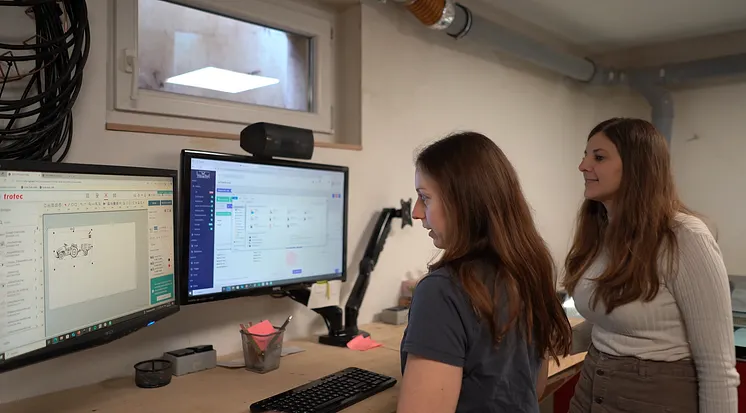
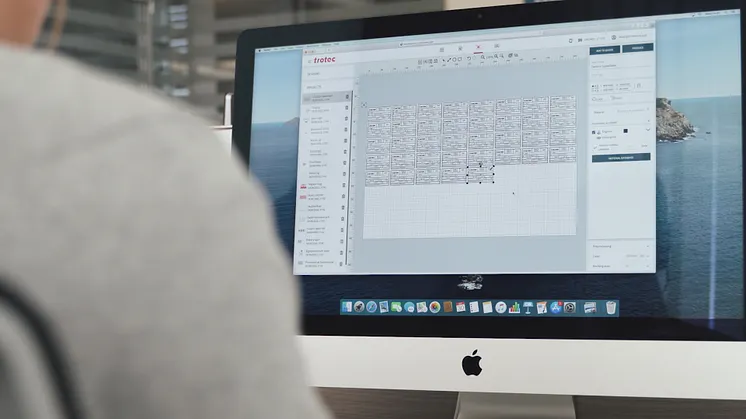
Against this backdrop, Trotec Laser has developed the Connected Throughput approach. The idea behind it is to make information available along the entire value chain just as reliably as materials and products. This understanding of digital production processes gave rise to the Trotec Laser software Ruby®, which brings together order management, job preparation, and production control in a single environment. Rather than optimizing individual process steps in isolation, the entire flow of information is taken into account. The goal is to reduce media breaks, standardize recurring processes, and improve collaboration between order management, job preparation, and production. Multiple users can work in parallel, centrally manage roles and permissions, and coordinate various laser systems within a unified structure. Job preparation is performed independently of the machine and across platforms on Windows and Mac systems.
Rethinking Productivity
The increasing customization of products will continue to intensify in the coming years. For engraving and marking companies, this means that economic growth cannot be achieved solely through higher processing speeds.
Rather, the decisive factor will be the ability to efficiently manage rising order volumes, variable data, and more complex production workflows. Companies that digitize their information flows and standardize their processes lay the foundation for scalable, reproducible, and cost-effective manufacturing.
For many engraving and marking companies, the decisive factor for success in the future will therefore be less the maximum processing speed of a machine and more the ability to seamlessly integrate data, orders, and production processes.
Related links
Topics
Categories
Trotec is a global leader in laser technology, setting new standards in the field. As part of the TroGroup, this European innovation leader develops, produces and markets laser systems and machines for marking, cutting and engraving a variety of materials and substances. The product portfolio is rounded off with extraction systems and laser and engraving materials. Trotec's 14 sales subsidiaries and around 700 employees support more than 40,000 systems in 90 countries. The export share is 97 per cent, and the current turnover for 2022 is €161 million. www.troteclaser.com