Royal Honour as leading researcher awarded Polar Medal
Professor John Woodward of Northumbria University has been awarded The Polar Medal in recognition of his outstanding work and contribution to UK scientific knowledge of the polar regions.
The inaugural cohort of Civil Engineering degree apprentices have graduated from Northumbria University, marking a significant milestone in addressing the UK's infrastructure skills gap.
Research led by polar scientists from Northumbria University has revealed new hope in natural environmental systems found in East Antarctica which could help mitigate the overall rise of carbon dioxide in the atmosphere over long timescales.
Pioneering research launches in Leeds to test new approach to assessing the risk to children from hidden lead exposure.
Researchers have achieved a breakthrough in solar physics by providing the first direct evidence of small-scale torsional Alfvén waves in the Sun's corona – elusive magnetic waves that scientists have been searching for since the 1940s.
The renowned architect, author and TV presenter George Clarke has been appointed as the new Chancellor of Northumbria University, Newcastle.
Researchers from an outreach group at Northumbria University are celebrating after winning a prestigious 2025 Institute of Physics (IOP) award recognising their work with children and young people across the North East and beyond.
A study of Saturn's atmospheric structure using data from the James Webb Space Telescope (JWST) has revealed complex and mysterious features unseen before on any planet in our Solar System. The results were presented last week by Professor Tom Stallard of Northumbria University, at the EPSC-DPS2025 Joint Meeting in Helsinki.
Two Northumbria students have been announced as winner at the RIBA North East Student Awards for RIBA Part 1 and RIBA Part 2. These wins continue a successful run for our Architecture students, following recognition at the Architects for Health Student Design Awards and the RIBAJ/Future Architects Film Competition 2025.
Northumbria University is expanding and enhancing the support it provides to students receiving their A-level, AS-level, VTQ and T-level results next week. This year, for the first time, staff will be based at schools and colleges across the region. They will meet students as they receive their results and will be able to make on-the-spot offers of a place at Northumbria to eligible students.
Researchers are set to shine a different kind of light on the farming industry after receiving funding to explore how fluorescent materials used in TV and phone screens can be used to detect the presence of pesticides and herbicides in food production.
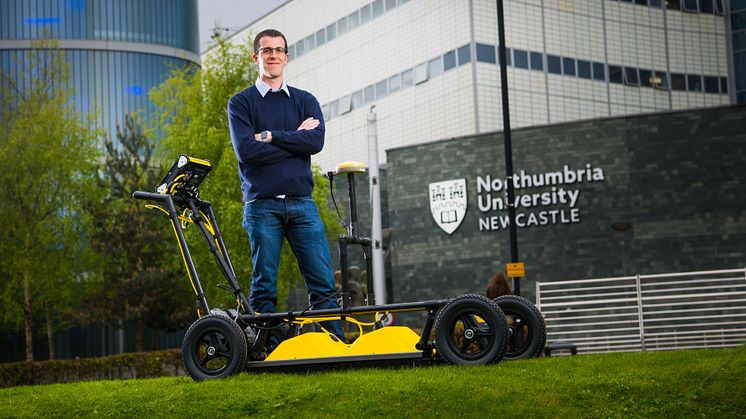
Northumbria University will host the 21st International Conference on Ground Penetrating Radar (GPR 2026) from June 23-26, 2026. The event will gather experts to discuss advancements in GPR technology for subsurface exploration, infrastructure monitoring, and utility imaging.
Dr. Pete Howson from Northumbria University is researching the impact of UK spaceports on local communities and environments, advocating for ethical development in the burgeoning NewSpace industry while aiming to balance commercial opportunities with social justice and sustainability concerns.
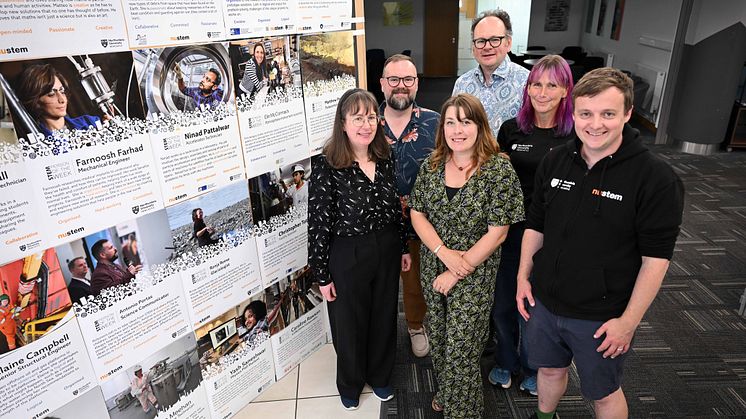
An outreach group from Northumbria University is celebrating a decade of STEM engagement in the North East and beyond, and has recorded over 170,000 interactions with children, families and teachers in that time.
A consortium of academic and industry partners has come a step closer to launching the UK’s first university-led multi-satellite space mission after announcing it has successfully built and tested its first CubeSats.
Scientists at Northumbria University have made a breakthrough in developing a new type of ‘microwave amplification by stimulated emission of radiation’ device, known as a maser.
Scientists have found evidence that the Asian continent was free of permafrost all the way to its northerly coast with the Arctic Ocean when Earth’s average temperature was 4.5˚C warmer than today, suggesting that the whole Northern Hemisphere would have also been free of permafrost at the time.
In this article originally written for The Conversation*, Dr Muhammad Wakil Shahzad, Associate Professor and Head of Subject, Mechanical and Construction Engineering at Northumbria University, discusses a possible solution to the environmental impact of AI data centres.
Northumbria University has been awarded a prestigious Marie Skłodowska-Curie Actions (MSCA) Fellowship to lead innovative research into low-carbon, 3D-printed construction materials.
Academics from Northumbria University and University College London have collaborated on a prestigious pavilion exhibition at the 2025 London Design Biennale, exploring an emerging field which intertwines biology with architecture.