Skip to content

Topics: Technology, general

  • Tiny droplets open the doors to in-flight imaging of proteins

    For the first time, researchers have demonstrated the creation of a beam of nanodroplets capable of delivering a variety of biological samples, from cell organelles to single proteins, virtually free from any contaminations, to the focus of an X-ray laser which can be used to image them.
  • Magnetic antiparticles offer new horizons for information technologies

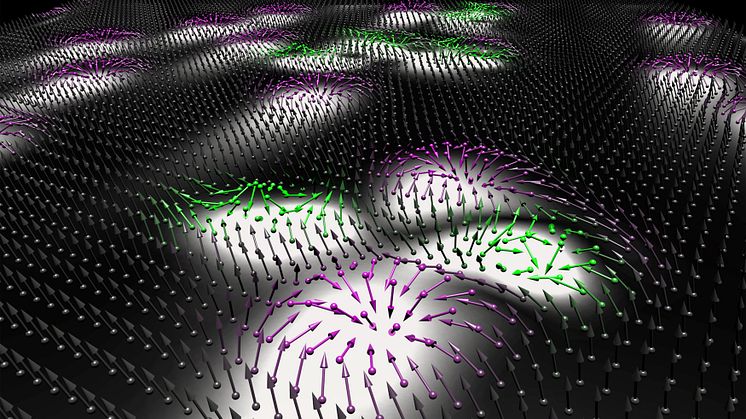
    Nanosized magnetic particles called skyrmions are considered highly promising candidates for new data storage and information technologies. Now, physicists have revealed new behaviour involving the antiparticle equivalent of skyrmions in a ferromagnetic material. The results are published in Nature Electronics.

  • New method enables high-resolution measurements of magnetism

    In a new article, published in Nature Materials, researchers from Beijing, Uppsala and Jülich have made significant progress allowing very high resolution magnetic measurements. With their method it is possible to measure magnetism of individual atomic planes.

  • Synthetic chemistry and biology in new method for more efficient hydrogen gas production

    Hydrogen gas has long been proposed as a promising energy carrier for future energy applications, but generating the gas from water has proved inefficient. In an article in the journal Energy and Environmental Science, scientists at Uppsala University now present an alternative, interdisciplinary method based on principles from nature.

  • Magnetism under the magnifying glass

    Being able to determine magnetic properties of materials with sub-nanometer precision would greatly simplify development of magnetic nano-structures for future spintronic devices. In a new study Uppsala physicists make a big step towards this goal - they propose and demonstrate a new measurement method capable to detect magnetism from areas as small as 0.5 nm2.

  • Simplified approach to drug development with Upsalite

    For the first time, researchers have revealed the nanostructure of the mesoporous magnesium carbonate Upsalite® and pore size control was achieved without organic templates or swelling agents. By controlling the pore structure of the material the amorphous phase stabilisation exerted on poorly soluble drug compounds can be tuned and the drug delivery rate can be tailored.

  • ​New method to create terahertz radiation advances materials science

    Uppsala physicists have in an international collaboration developed a new method for creating laser pulses which are shorter, have much higher intensity and cover the THz frequency range better than current sources. The study is published today in the authoritative journal Nature Photonics and is of great importance to materials research.

  • Anti-ageing treatment for smart windows presented in a new study

    Electrochromic windows, so-called ‘smart windows’, share a well-known problem with rechargeable batteries – their limited lifespan. Researchers at Uppsala University have now worked out an entirely new way to rejuvenate smart windows which have started to show signs of age. The study, published in the distinguished science journal Nature Materials, may open the way to other areas of application.

  • Overview and analysis of ICT research gives fresh perspectives

    ​The effect of Internet on our lives and society is a constant topic of interest for politicians, business leaders, the media and the general public, an interest that has generated a substantial body of research on the use of ICT. In a newly published dissertation, ICT researcher Håkan Selg highlights the need for theoretical awareness to strengthen the role of research as a source of knowledge.

  • Smart, ecofriendly new battery to solve problems

    Present-day lithium batteries are efficient but involve a range of resource and environmental problems. Using materials from alfalfa (lucerne seed) and pine resin and a clever recycling strategy, Uppsala researchers have now come up with a highly interesting alternative. Their study will be presented soon in the scientific journal ChemSusChem.

  • Supermaterial gives rejected drugs a new chance

    More than 80 percent of all drug candidates in the pharma R&D suffer from poor solubility and are therefore rejected early in the drug discovery process. Now Uppsala University researchers show that the new material Upsalite®, has great potential for development of new formulations of these rejected drugs.

  • Lactase persistence alleles reveal ancestry of southern African Khoe pastoralists

    In a new study a team of researchers lead from Uppsala University show how lactase persistence variants tell the story about the ancestry of the Khoe people in southern Africa. The team concludes that pastoralist practices were brought to southern Africa by a small group of migrants from eastern Africa. The study is now published in Current Biology.

  • Nano-paper filter removes viruses

    Researchers at the Division of Nanotechnology and Functional Materials, Uppsala University have developed a paper filter, which can remove virus particles with the efficiency matching that of the best industrial virus filters. The paper filter consists of 100 percent high purity cellulose nanofibers, directly derived from nature.

  • Surprising findings on hydrogen production in green algae

    New research results from Uppsala University instil hope of efficient hydrogen production with green algae being possible in the future, despite the prevailing scepticism based on previous research. The study, which is published today in the esteemed journal PNAS, changes the view on the ability of green algae – which is good news.

  • New technology platform launched at SciLifeLab in Uppsala

    An advanced chip that swiftly and with extremely high sensitivity can measure 92 different tumour proteins from 92 different patients is now available at SciLifeLab in Uppsala. The new technology will become an important resource for researchers and companies developing diagnostics for different illnesses.

  • First experimental plant for marine current power to be installed in Dalälven

    Journalists are welcome to the river Dalälven, in the rural Swedish town of Söderfors, when the first experimental plant for marine current power will be installed on March 7. The aim is to develop new technology for utilising renewable marine current power as a means for producing electricity.

Show more