News —
Hanau’s New CHP Plant Paves the Way for Low-Carbon Heating
The new Gemeinschaftskraftwerk Hanau (GKH) combined heat and power plant now supplies district heating to almost 20,000 households in Hanau and Großkrotzenburg. Located on the site of the former Großauheim barracks, three hydrogen-ready gas engines generate heat and electricity around the clock, with the electricity fed into the local grid. The facility, jointly owned by Stadtwerke Hanau and Mainova, is complemented by a 240 kW photovoltaic installation on its roof and south- and west-facing façades.
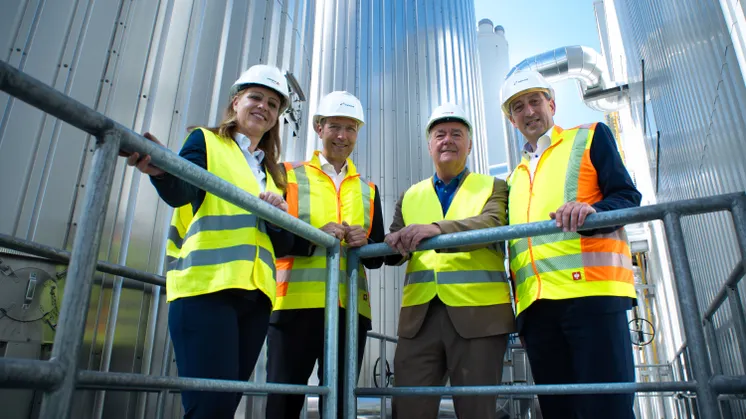
Shortly before the start of the heating season, Lord Mayor Claus Kaminsky, Stadtwerke Hanau Managing Director Martina Butz and Mainova Executive Board members Dr Michael Maxelon and Martin Giehl visited the site to learn about the new plant’s operations.
Lord Mayor Kaminsky said: “The joint power plant has taken over the heat supply previously provided by the Staudinger power station. I am delighted that the planned phase-out of coal has become a reality during my term of office and that our municipal utility is now responsible for producing heat for Hanau and Großkrotzenburg. This makes the supply secure and fit for the future. It puts our municipal utility in control of both supply and the further decarbonisation of generation. The switch from coal to gas alone reduces CO₂ emissions by 40 per cent, or 45,000 tonnes a year.”
Stadtwerke Hanau Managing Director Martina Butz added: “With the new joint power plant, we are moving step by step towards our goal of supplying our customers with decarbonised heat – securely and efficiently. Climate protection also plays an important role in electricity supply. Alongside the electricity generated through combined heat and power at the plant, photovoltaic modules produce electricity for on-site use. Hanau’s first solar park, with a capacity of 10 megawatts, and the new substation operated by our subsidiary Hanau Netz, both located nearby, complete this innovative energy concept. My thanks go to our strategic partner Mainova, with whom we are continuing our successful collaboration through the joint operation of the plant.”
Dr Michael Maxelon, CEO of Mainova, looked ahead: “Decarbonising the heat supply is one of the greatest challenges of the energy transition, as it still relies predominantly on fossil fuels. With the Hanau joint power plant, we are building the infrastructure today for tomorrow’s heat supply. The project combines security of supply, economic viability and climate protection, demonstrating how regional partners can successfully advance the energy transition locally.”
Mainova Executive Board member Martin Giehl added: “Through close cooperation, we have successfully delivered an early coal phase-out in Hanau and secured the city’s long-term heat supply. The joint power plant combines energy efficiency with technology designed for the future. By using combined heat and power, the facility achieves an overall efficiency of more than 90 per cent, making highly efficient use of fuel to generate both electricity and heat. The plant is also hydrogen-ready, laying the foundations for a future-proof heat supply.”
Background to GKH
In 2021, Stadtwerke Hanau and Mainova established the joint company Gemeinschaftskraftwerk Hanau GmbH & Co. KG to build the power plant and operate it following completion. At the heart of the facility are three state-of-the-art, hydrogen-ready gas engines that generate electricity and heat simultaneously using combined heat and power (CHP) technology. The CHP plant has a total thermal output of 30 megawatts and an electrical output of 30 megawatts. ENGIE Deutschland was awarded the construction contract as general contractor.
GKH operates at an overall efficiency of more than 90 per cent, converting most of the fuel’s energy into electricity and useful heat. By comparison, conventional power plants achieve efficiencies of only 40 to 60 per cent. This efficient technology and the initial switch from coal to gas reduce CO₂ emissions from Hanau’s district heating supply by 40 per cent.
In the future, waste heat from the neighbouring data centre is to be integrated into GKH’s energy system, which would further reduce CO₂ emissions. In a final step, green hydrogen is to be introduced as a fuel, provided sufficient quantities are available.
GKH Technical Specifications
- Three CHP units, each with approximately 10 MW of thermal output and 10 MW of electrical output
- Two hot-water boilers, each with an output of 8 MW, serving as backup
- Two buffer storage tanks (pressurised thermal storage), approximately 40 MWth
- Three district heating pumps