Pressemitteilung —
Hydrogen Imports, Pipeline Conversion, Process Heat: The Winners of the New Gases Innovation Award
- Three award-winning projects showcase solutions for hydrogen imports, converting gas pipelines, and using new gases in industry.
- The New Gases Innovation Award is presented by the industry associations BDEW, DVGW, and Die Gas- und Wasserstoffwirtschaft.
- Jury chair Prof. Dr.-Ing. Albert Moser: “The award-winning projects show how technological innovations can lead to practical solutions for energy supply and industry. They demonstrate that businesses and researchers are developing viable, forward-looking answers to the complex challenges facing our infrastructure – even in a demanding global environment.”
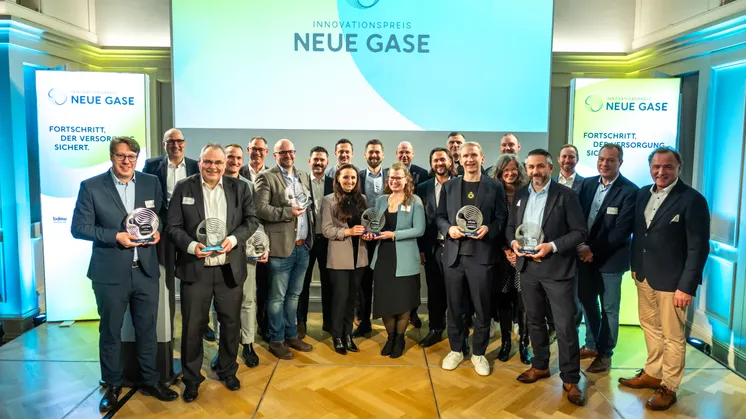
Three pioneering projects have received the 2026 New Gases Innovation Award. The awards ceremony took place in Berlin on November 9 under the patronage of Federal Research Minister Dorothee Bär. The award was presented by the three industry associations BDEW, DVGW, and Die Gas- und Wasserstoffwirtschaft.
The jury selected the following projects in the three categories: the Scholven ammonia-cracking demonstration plant by Uniper SE and thyssenkrupp Uhde; ONTRAS’s Green Octopus project, which uses EMPIT’s CMI technology to inspect existing gas pipelines for hydrogen transport with the help of AI; and the flexible BrEEga industrial burner by GWI Essen and Friedrich Ley. An Audience Award was also presented to one of the nominees. In October, the Scholven demonstration plant was selected for that award as well.
The jury, chaired by Prof. Dr. Albert Moser of RWTH Aachen University’s Institute for Electrical Equipment and Grids, Digitalisation and Energy Economics, particularly praised the wide range of submissions. They show how businesses and researchers are responding to the demands of a challenging market environment. The projects also illustrate the role that new gases such as hydrogen and biogas can play in developing the energy system.
“This year’s submissions clearly demonstrate that biogas and hydrogen are no longer abstract options for the future. They are already making a difference where they help secure energy supplies and enable successful industrial transformation,” said Prof. Dr.-Ing. Albert Moser, chair of the jury. “The New Gases Innovation Award makes this progress tangible: it specifically recognizes projects that are already delivering measurable benefits to the energy system and can serve as blueprints for the entire market.”
The winners by category:
Production
Scholven ammonia-cracking demonstration plant
Uniper SE and thyssenkrupp Uhde
The demonstration plant in Scholven provides an important technical impetus for ammonia cracking on an industrial scale. It opens up opportunities to import large quantities of ammonia produced from renewable hydrogen from around the world and make that hydrogen available to industry. The jury particularly recognized the technology’s potential to be replicated in other projects and to open up new supply routes for hydrogen. The project could thereby strengthen Germany as a business and industrial location.
Transport and Infrastructure
Current Magnetometry Inspection (CMI) & Green Octopus
EMPIT, ONTRAS Gastransport
EMPIT’s CMI technology was used in ONTRAS’s Green Octopus project. The autonomous, AI-supported inspection method assesses the condition of existing natural gas pipelines and helps determine whether they are suitable for hydrogen transport. The data collected help prepare for pipeline conversion at lower cost. The innovative CMI concept has a practical application in Green Octopus and provides an important foundation for converting existing natural gas pipelines to hydrogen. The jury was particularly impressed that this autonomous, AI-supported inspection method can readily establish whether existing gas infrastructure can be used safely to supply hydrogen. This can reduce infrastructure operators’ operating costs and significantly advance the development of a high-capacity hydrogen infrastructure.
Applications
BrEEga
Gas- und Wärme-Institut Essen e. V. (GWI), Friedrich Ley
BrEEga is an innovative burner system that reduces fossil CO₂ emissions by enabling the flexible use of gases from renewable sources and industrial process gases. It allows industrial companies to switch their process heat supply flexibly between different gases. The project provides a basis for investment decisions at a time when the future availability of different energy sources is still taking shape. The jury particularly recognized how the project combines flexible process heat with business agility: companies can adapt their energy supply to changing conditions and strengthen their competitiveness and resilience.
The award-winning projects show what it takes to scale up the use of new gases: hydrogen must be made available in large quantities, existing infrastructure must be adapted for its transport, and industry must be able to use renewable and low-carbon gases flexibly. This requires innovation throughout the value chain. The winners of the 2026 New Gases Innovation Award demonstrate how businesses are addressing these challenges with practical technological solutions.
Kategorien
Als Stimme der Branche bündelt der Verband DIE GAS- UND WASSERSTOFFWIRTSCHAFT e.V. die Interessen seiner Mitglieder und setzt sich dafür ein, dass die Potenziale von Wasserstoff und seiner Derivate sowie Biogas und Erdgas inklusive der dazugehörigen Infrastruktur genutzt werden. Zudem informiert er über den Beitrag gasförmiger Energieträger und ihrer Infrastruktur zu einer sicheren Energieversorgung sowie über die Möglichkeiten, Treibhausgasemissionen durch den Einsatz von Wasserstoff, seinen Derivaten und Biogas zu senken. Zugleich treibt er die Transformation der Branche hin zu neuen Gasen voran. Der Verband wird von führenden Unternehmen der Energiewirtschaft getragen und umfasst die gesamte Wertschöpfungskette von Produktion, Transport, Verteilung bis hin zu Handel, Vertrieb und Anwendungen. Weitere Branchenverbände und Industrieunternehmen unterstützen ihn als Partner.