Pressmeddelande —
Ilona Sagar’s First Solo Exhibition in Sweden Explores the Aaltos’ Groundbreaking Sanatorium
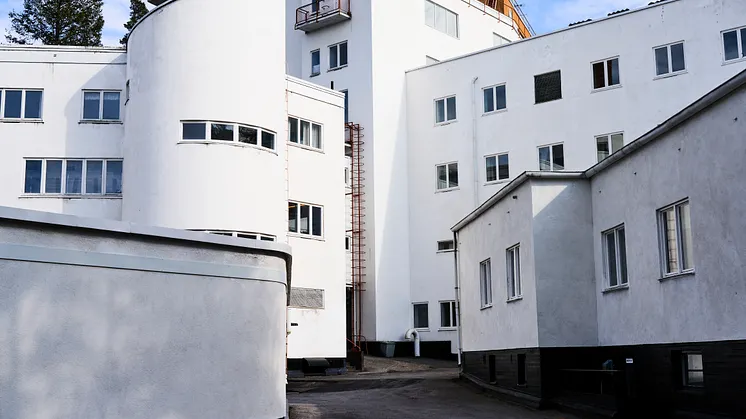
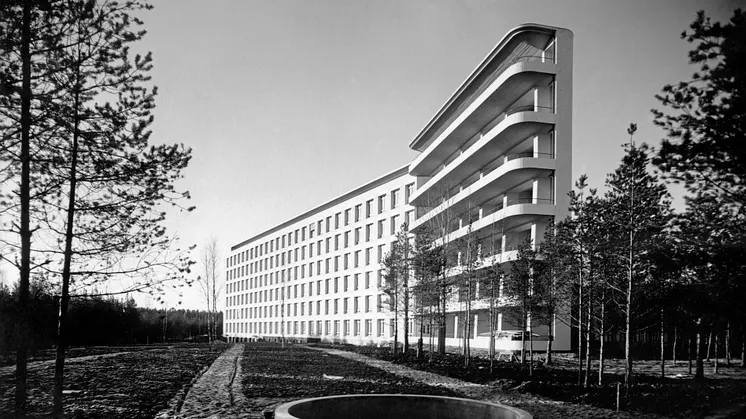
The exhibition Ilona Sagar: Omsorgens arkitektur offers an in-depth exploration of Aino and Alvar Aalto’s modernist tuberculosis sanatorium in Paimio, recently inscribed on the UNESCO World Heritage List. Through an immersive video installation, images and original objects, the exhibition examines the relationship between health, the body and architecture. It opens at the Röhsska Museum on 7 November.
– Paimio Sanatorium is one of the most celebrated works of architecture in the Nordic region. In British artist Ilona Sagar’s new film installation Other Actors, the focus shifts to the people who lived, worked and received care there. We encounter experiences and voices rarely heard in conventional historical narratives, says Olivia Berkowicz, curator at the Röhsska Museum.
Alongside Ilona Sagar’s film installation, the exhibition brings together some twenty design objects, images, drawings and archival materials from the sanatorium, on loan from the Alvar Aalto Foundation, Artek and the Paimio Sanatorium Foundation.
– Many of the design ideas that emerged from Paimio are still deeply relevant today. The Aaltos were pioneers of a humanistic approach to design, yet their work has often come to be seen as highly desired design classics, detached from the intentions and politics that shaped them. I hope the exhibition allows for a different reading of these histories, one that brings some of their radicality back into view, says Ilona Sagar.
The exhibition is Ilona Sagar’s first solo exhibition in Sweden and has been designed by Swiss designer Adrien Rovero. Sagar is also currently nominated for the Jarman Award, one of the UK’s foremost prizes for artists working with moving image.

Human-Centred Architecture Rooted in Care
The tuberculosis sanatorium in Paimio was completed in 1933 and marked the international breakthrough of architects Aino and Alvar Aalto. As an early precursor of patient-centred care, the sanatorium was designed with the ambition that the architecture itself would aid patients’ recovery. Light, ventilation, colour schemes and specially designed furniture were all carefully adapted to the needs of vulnerable patients, taking into account the horizontal perspective from their beds. Even details such as silent washbasins and hygienic spittoons were designed with both the individual and the wider community in mind.
New Perspectives on Architectural History
The exhibition highlights the collective work behind the sanatorium, paying particular attention to Aino Aalto’s central role in the project’s design — a project that has long been associated primarily with Alvar Aalto.
– Fifty years after Alvar Aalto’s passing, we want to offer new perspectives on one of the Aaltos’ most significant works. Developing the exhibition has deepened our understanding of Aino Aalto’s role and helped us improve representation within the museum’s collections. Ilona Sagar’s work also raises questions about the ways in which architecture affects people’s health, wellbeing and relationships—questions that are just as urgent today as they were when the sanatorium was built, says Nina Due, Director of the Röhsska Museum.
The exhibition Ilona Sagar: Omsorgens arkitektur is on view at the Röhsska Museum from 7 November 2026 to 5 June 2027.
The exhibition is supported by Kulturfonden för Sverige och Finland.
Relaterade länkar
Ämnen
Kategorier
Regioner
Röhsska museet är Sveriges museum för design, mode och konsthantverk
Röhsska museet ligger alldeles vid Avenyn i centrala Göteborg och visar design, mode och form från olika stilar och epoker. Museet öppnade 1916 som Sveriges enda specialmuseum för design och konsthantverk.
Museet har en unik samling som omfattar cirka 50 000 föremål, från 4 500 år gamla arkeologiska fynd till nutida skandinavisk formgivning. Museets stora kinesiska samling är idag en av Europas äldre museisamlingar.
Genom utställningar, samlingar, pedagogik och programaktiviteter undersöker Röhsska museet hur form, mode och design har påverkat oss genom historien och på väg mot framtiden.
Röhsska museet är en del av Göteborgs Stads kulturförvaltning. Samfinansierat av Västra Götalandsregionen.