
News —
Lipedema, Obesity or Normal Fat Legs? What Lipedema Legs Look Like in Singaporeans
Updated on Oct 26, 2026
Lipedema in the legs is a chronic medical condition that causes painful, symmetrical fat buildup in both legs, with easy bruising and a “cuff” of fat at the ankles that spares the feet. Unlike obesity or ordinary “fat legs”, lipedema fat is tender and doesn’t respond to diet and exercise. It is often misunderstood as obesity and misdiagnosed as lymphedema or cellulite [1].
Key Takeaways
- Lipedema is not obesity or “fat legs.” It is a chronic medical condition, often misunderstood as obesity and misdiagnosed as lymphedema or cellulite [1].
- Pain is the dividing line. Lipedema legs are tender, swollen and bruise easily, and the fat resists diet and exercise. Ordinary fat legs usually aren’t painful.
- Look for the cuff. Fat builds up symmetrically in both legs and stops at the ankles, sparing the feet.
- There are 3 stages and 5 types. Stage 1 looks smooth but feels nodular [2], Stage 2 shows fibrosis and a mattress-like pattern [2], and Stage 3 has tissue folds [2]. Types describe where the fat sits.
- Treatment goes beyond diet. Compression, MLD and low-impact exercise [4] help manage symptoms, and liposuction is the clinically proven surgical option [5].

What are the stages and types of lipedema in the legs?

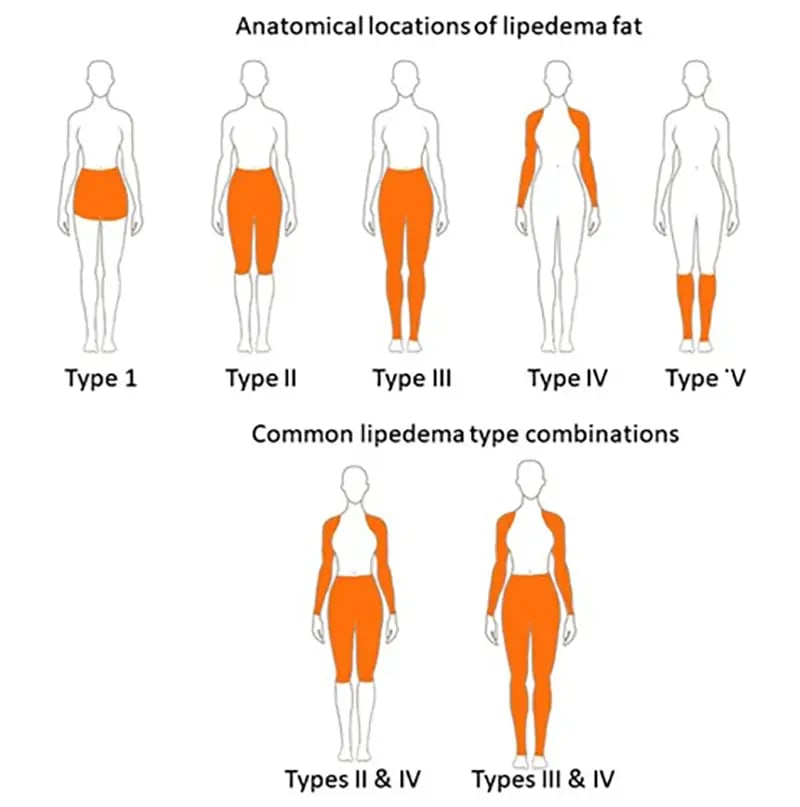
Lipedema is mainly seen in women. It is abnormal fat buildup distributed unevenly in the limbs, including the buttocks, thighs, lower legs and arms. It comes in 5 types (where the fat sits), each with 3 stages (how advanced it is).
The 3 stages of lipedema in the legs
| Stage | What it looks and feels like |
|---|---|
| Stage 1 (Mild) | Skin is smooth and the legs can look normal, but there is pain, easy bruising and a nodular feel to the fat tissue [2] |
| Stage 2 (Moderate to severe) | The fat has a mattress-like pattern, indicating fibrosis under the skin that tethers to the skin. It may affect the upper legs (Type II) or extend to the ankles (Type III) [2] |
| Stage 3 (Advanced) | Folds of tissue appear, and the fat usually extends down to the ankles [2] |
The 5 types of lipedema
| Type | Where the fat accumulates |
|---|---|
| Type I | Buttocks, pelvis and hips. |
| Type II | Buttocks down to the knees, with fat folds around the knees |
| Type III | Pelvis down to the ankles, with a “cuff” of fat that spares the foot |
| Type IV | Arms (shoulders to wrists). Rarely occurs alone |
| Type V | Lower legs, around the calves |
How do I know if I have fat legs or lipedema?
“Fat legs” is a common complaint among women with pear-shaped bodies. It means stubborn, localised fat in the lower body compared with the rest of the body, and it is generally influenced by genetics, diet and activity level.
The main differences:
- Pain and tenderness: Lipedema is typically painful or tender. Fat legs usually are not.
- Swelling: Lipedema causes disproportionate swelling in the affected areas. Fat legs don’t.
- Bruising: People with lipedema bruise easily. People with fat legs don’t.
Lipedema is not the same as normal fat legs or obesity. It is a chronic medical condition.
Lipedema vs obesity vs fat legs: Key differences
| Lipedema | Obesity | Fat Legs | |
|---|---|---|---|
| What is it? | A chronic condition that mainly affects women, causing symmetrical fat buildup in the legs and sometimes the arms and lower body | A chronic disease marked by harmful levels of body fat. A BMI over 25 is overweight and over 30 is obese | Localised fat on the inner and outer thighs, knees or calves. It can affect anyone, at any BMI |
| Is it harmful? | Known as a painful fat disease. Untreated, it can lead to serious mental health issues and complications | Raises the risk of type 2 diabetes, heart disease and certain cancers, and affects bone health, reproduction, sleep and mobility | Usually an aesthetic concern |
| Causes | Exact causes unclear. Often starts or worsens during puberty, pregnancy or menopause. Research continues into hormones, genetics, inflammation and metabolism | Genetics, lack of exercise, unhealthy lifestyle | Genetics, lack of exercise, unhealthy lifestyle |
| Fat pattern | Symmetrical in both legs, sometimes the arms and lower body. Hands and feet usually spared, creating a “cuff” at the ankles or wrists | Mainly the abdomen, waist, hips, thighs and upper arms | Disproportionate shape, typically in pear-shaped bodies |
| Easy bruising | Yes | No | No |
| Response to diet and exercise | Poor | Usually responds | May not reduce fat in those specific areas, even at a normal BMI |
| Other symptoms | Lumpy or fibrous areas, with an uneven, dimpled look. Swelling (oedema) and overly flexible joints (hypermobility) can occur | Difficulty moving, shortness of breath, joint stiffness, stretch marks, chafing and skin folds | Stretch marks and thigh chafing. May have cellulite and skin folds |
| Pain and tenderness | Yes | Yes | No |
| Swelling | Yes | Yes | No |
| Non-surgical options | Compression therapy, manual lymphatic drainage (MLD), low-impact exercise such as water aerobics [4] | Calorie-controlled, nutritious diet and regular aerobic exercise | Fat freezing (cryolipolysis) for localised fat |
| Surgical options | Liposuction, an effective and clinically proven treatment for lipedema [5] | Bariatric surgery may be recommended | Liposuction |
When to seek help
Women with lipedema in the legs often live with significant pain and symptoms that others can’t see. Raising awareness in Singapore helps women get the care they need. If you have painful, tender, easily bruised legs that don’t respond to diet and exercise, see a doctor experienced in lipedema.
FAQ
How does pregnancy affect lipedema in the legs?
Pregnancy can worsen lipedema in the legs. Major hormonal shifts and fluid retention over the nine months may increase heaviness, tenderness, soreness and swelling. Experiences vary between women.
Can you stop leg lipedema from getting worse?
You may be able to slow progression by:
- Keeping a healthy lifestyle and good daily skin care.
- Moving often with light exercise, such as walking while raising your arms.
- Having regular manual lymphatic drainage (MLD) massages.
- Wearing compression garments to manage swelling.
Early intervention leads to better outcomes.
What type of liposuction can treat lipedema in the legs?
Liposuction for lipedema uses a gentle, specialised approach, such as Vaser Lipo (UAL), combined with Dr Ivan Puah’s Modern Liposuction With MDC-Sculpt® Lipo Technique. It removes diseased fatty tissue in a multi-dimensional manner while leaving surrounding tissues untouched. The aim is minimal downtime and smoother results that keep the body’s natural curves, with minimal scarring.
What is the “cuff sign” in lipedema?
It is a visual sign that shows where the painful fat stops. A cuff of fat forms around the ankle, and the fat does not extend onto the foot. A similar cuff can form at the wrist in the arms.
Can lipedema in the legs affect vein health?
Yes. Many patients with lipedema have been reported to have venous insufficiency, depending on the stage and type. This happens when leg veins struggle to return blood to the heart, leading to varicose veins, skin discolouration and slow-healing leg ulcers. Venous insufficiency can in turn worsen lipedema symptoms.
Reference
[1] Łyszczak, P., & Szuba, A. (2018). Lipedema: a clinical entity. Acta Angiologica, 24(4), 141-148.
[2] Herbst KL. Subcutaneous Adipose Tissue Diseases: Dercum Disease, Lipedema, Familial Multiple Lipomatosis, and Madelung Disease. [Updated 2019 Dec 14]. In: Feingold KR, Anawalt B, Blackman MR, et al., editors. Endotext [Internet]. South Dartmouth (MA): MDText.com, Inc.; 2000-.
[3] Eakin, G. S., & Peterson, S. (2023). Lipedema: A Current Understanding of its Pathology and Natural History Version 1-May 2023.
[4] Amato ACM, Benitti DA. Lipedema Can Be Treated Non-Surgically: A Report of 5 Cases. Am J Case Rep. 2021 Dec 6;22:e934406. doi: 10.12659/AJCR.934406. PMID: 34871293; PMCID: PMC8667633.
[5] Rapprich, S., Dingler, A., & Podda, M. (2011). Liposuction is an effective treatment for lipedema–results of a study with 25 patients. JDDG: Journal der Deutschen Dermatologischen Gesellschaft, 9(1), 33-40.
[6] Melander, C., Juuso, P., & Olsson, M. (2021). Women’s experiences of living with lipedema. Health Care for Women International, 43(1–3), 54–69. https://doi.org/10.1080/073993... 1 & 2] Herbst KL. Subcutaneous Adipose Tissue Diseases: Dercum Disease, Lipedema, Familial Multiple Lipomatosis, and Madelung Disease. [Updated 2019 Dec 14]. In: Feingold KR, Adler RA, Ahmed SF, et al., editors. Endotext [Internet]. South Dartmouth (MA): MDText.com, Inc.; 2000-. Available from: https://www.ncbi.nlm.nih.gov/books/NBK552156/
[Figure 1 & 2] Herbst KL. Subcutaneous Adipose Tissue Diseases: Dercum Disease, Lipedema, Familial Multiple Lipomatosis, and Madelung Disease. [Updated 2019 Dec 14]. In: Feingold KR, Adler RA, Ahmed SF, et al., editors. Endotext [Internet]. South Dartmouth (MA): MDText.com, Inc.; 2000-. Available from: https://www.ncbi.nlm.nih.gov/b...