Press release —
A new class of fungi named after the King of Sweden
Researchers at Uppsala University have discovered a completely new fungal species, which they chose to name after the King of Sweden. The species has been given the Latin name Semicentenialea rex, which means fifty-year anniversary of the King. It is the first known representative of a new class of fungi that will be called Semicentenialomycetes.
The new fungus was isolated from roots in the ground in Jädraås in the province of Gästrikland, and represents a new lineage among what are primarily rust fungi. Rust fungi are a type of fungi that causes diseases in plants, usually by infecting the leaves. Based on DNA sequencing from soil samples, the researchers know that the class occurs in soil and roots from different ecosystems across almost the entire world, but rarely at high abundance.
“There are probably at least two other species in the class, but they do not appear to be as common as Semicentenialea rex. Since it only seems to live deep down in the ground, we are curious about what life strategy it has. We are going to study how it affects the roots of plants in the soil and how it propagates,” says Anna Rosling, professor at Uppsala University and one of the researchers behind the study.
Several million species of fungi
The species diversity in kingdom Fungi is largely unexplored. Based on sequencing of environmental DNA, it is estimated that there are several million species of fungi across the globe. But because most live concealed in the soil, wood or insects for example, it has only been possible to describe and name a small proportion of them. Without names, it is difficult to communicate about these species, genera, classes and even phyla of hitherto unknown fungi.
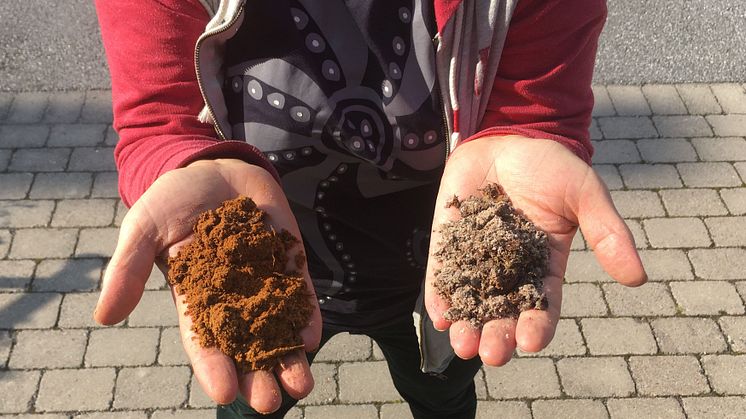
It was during a study root fungal diversity, when the researchers were culturing fungi from pine tree roots collected from mineral soil at Ivantjärnheden field station near Jädraås (150 km north of Uppsala) that the researchers identified a new fungal species that turned out to represent a new class of fungi.
Exciting with a root-associated fungus
Veera Tuovinen-Nogerius and Anna Rosling, both of Uppsala University, have led an international team of researchers in the work of characterising the morphology of the new species and its phylogenetic placement. The results have now been published in the International Mycology Association’s journal IMA Fungus.
“A new class is exciting enough but in this case, it’s especially exciting because we have a root-associated fungus that evolutionarily speaking sits among the rust fungi in Puccinomycotina. Rust fungi are obligate parasites that infect plants and cause diseases above ground,” says Anna.
Suitable named after King of Sweden
Finding names for new species is a pleasant challenge for all researchers doing this type of research. This particular one was named Semicentenialea rex to pay tribute to King Carl XVI Gustaf of Sweden when he celebrated 50 years on the throne in 2023.
“During his reign, the King has worked tirelessly for biodiversity conservation and the sustainable use of our natural resources. What could be better than to have a previously undescribed fungus named after you,” says Anna Rosling, who in connection with the official celebration of the King’s golden jubilee presented a picture and a description of the species to him.
Now that the species has a new name, it will facilitate future communication and studies of the role of Semicentenialea rex in the ecosystem.
Article: Nogerius VT, et al. (2026); Another dark taxon comes to light: Semicentenialomycetes, a new class within the Pucciniomycotina (Basidiomycota), and its first described representative, Semicentenialea rex. IMA Fungus 17: e189848. DOI: 10.3897/imafungus.17.189848
Contact information:
Anna Rosling, Professor at Department of Ecology and Genetics, Uppsala University,
mobile: +46 (0)73-066 08 33, e-mail: Anna.Rosling@ebc.uu.se
Related links
Topics
Categories
Founded in 1477, Uppsala University is the oldest university in Sweden. With more than 50,000 students and 7,500 employees in Uppsala and Visby, we are a broad university with research in social sciences, humanities, technology, natural sciences, medicine and pharmacology. Our mission is to conduct education and research of the highest quality and relevance to society on a long-term basis. Uppsala University is regularly ranked among the world’s top universities. www.uu.se