Press release —
Curiosity and fearlessness apparent in German Shepherd genes
German Shepherd dogs bred for working are more curious and less neurotic than German Shepherds bred for show. A new study from Uppsala University and the Swedish University of Agricultural Sciences has shown that the differences are not only apparent in the dogs’ behaviour, but also in their genes. In previous studies, similar genes in humans have been associated with neuroticism.
A German Shepherd dog’s behaviour is very important because they are used as working dogs, for example in the police force or in the defence forces. Breeding dogs with the right traits can be difficult and costly. But with a better understanding of the genetics underlying such traits, breeding can be improved.
In a new study, ethologists and geneticists worked together to investigate how the behaviour of German Shepherd dogs is reflected in their genes. They have shown that the German Shepherd population in Sweden is comprised of two groups: one bred primarily for their appearance and the other bred for functional roles as working dogs.
“Breeders of working dogs have selected and bred the ones that really enjoy working; it’s a bit like a game for them. It’s interesting that we can now see that this selective breeding has indeed led to differences between working dogs and show dogs among German Shepherds – differences that can be seen at both the behavioural and genetic levels,” says Kerstin Lindblad-Toh, Professor of Comparative Genomics at Uppsala University and one of the study’s leaders.
Investigated German Shepherd behaviour and genetics
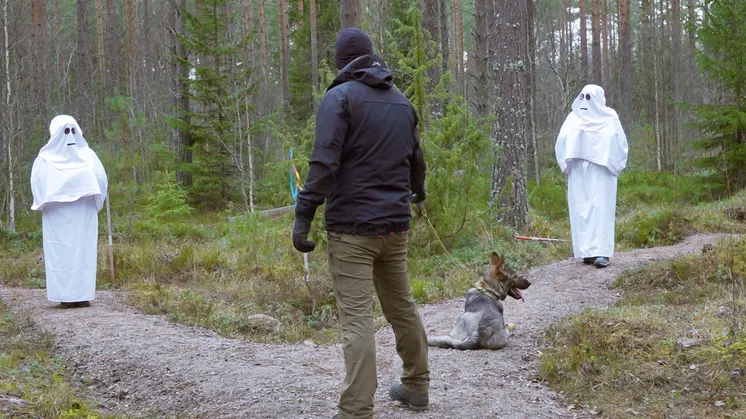
To measure behaviour in German Shepherd dogs, a standardised behaviour test called the Dog Mentality Assessment (DMA) was used where the dogs were confronted with a variety of situations. The DMA tests how dogs react to an invitation to play, threatening ghost-like figures, and being handled by a stranger. Today, the majority of German Shepherds in Sweden are tested using the DMA. In the study, the researchers looked at data from around 23,000 German Shepherd dogs.
“We could see that, on average, the working dogs showed less fear, more curiosity and were able to socialise well with humans. This shows how important it is to select for behaviour when selecting dogs for breeding for important functional roles in our community,” says Åke Hedhammar, Professor Emeritus at the Swedish University of Agricultural Sciences.
The researchers then took blood samples from 373 German Shepherd dogs who had undergone the DMA to be able to map their genomes.
“We could then see that there were areas in the genome where differences could be seen in the dogs depending on how curious or playful they were, for example. That meant that we were able to identify some of the genes in working dogs that are linked to curiosity and playfulness,” says Kerstin Lindblad-Toh.
In humans too, researchers have also found links between genes and behaviour. Some of the genes that have now been linked to the behaviour of German Shepherd dogs have been associated in previous studies with neuroticism in humans.
“It’s interesting that several of the genes that we identified as influencing behaviour in German Shepherds are also linked to that behaviour in humans. So we now have an example of how we might also acquire more knowledge about different behaviours in people with help of dogs in the long term,” says Kerstin Lindblad-Toh.
Bigger studies in the pipeline with the Swedish Armed Forces
Behaviour is not just controlled by individual genes: it is a complex interaction between many different genes. In collaboration with the Swedish Armed Forces, the researchers are now going to proceed with bigger studies in order to better map the genetics of behaviour.
“That would ultimately mean that these findings could be used to select which dogs have the best prospects of becoming good working dogs and which could be used in breeding. But we are not there yet. This study is just a first step and shows that there are actually clear differences in behaviour between working German Shepherd dogs and German Shepherd show dogs,” Åke Hedhammar says.
Watch a video showing how the Dog Mentality Assessment is carried out. Film/CC by: Voichita Marinescu
Contact
Kerstin Lindblad-Toh, Professor of Comparative Genomics at the Department of Medical Biochemistry and Microbiology, Uppsala University
Mobile phone number: +46 70-324 2336
E-mail: kerstin.lindblad-toh@imbim.uu.se
Åke Hedhammar, Professor Emeritus in diseases of dogs, Swedish University of Agricultural Sciences.
Mobile phone number: +46 70 622 27 96
E-mail: ake.hedhammar@slu.se
Article
Marinescu, V. D., Svartberg, K., Kierczak, M., Tengvall, K., Bianchi, M., Jabłońska, J., Arvelius, P., Sakthikumar, S., Farias, F. H. G., et al. (2026). The Genetic Architecture of Behavior in the German Shepherd Dog. Animal Genetics. doi: 10.1002/age.70221
Topics
Categories
Founded in 1477, Uppsala University is the oldest university in Sweden. With more than 50,000 students and 7,500 employees in Uppsala and Visby, we are a broad university with research in social sciences, humanities, technology, natural sciences, medicine and pharmacology. Our mission is to conduct education and research of the highest quality and relevance to society on a long-term basis. Uppsala University is regularly ranked among the world’s top universities. www.uu.se