Press release —
How the Atlantic herring adapted to the brackish water of the Baltic Sea
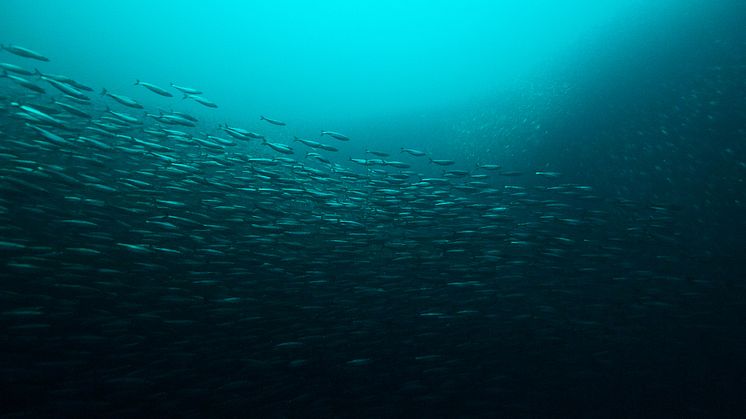
When the Atlantic herring colonised the Baltic Sea thousands of years ago, it needed to adapt to the low salinity. Genes with a vital role in the functioning of sperm, eggs and embryos were crucial to this adaptation. A new study by researchers from Uppsala University and other institutions, published in PNAS, shows that mutations in four specific genes were particularly important.
The Baltic Sea emerged after the last glaciation and has existed for only about 8,000 years. An early coloniser, the herring is one of the few Atlantic fishes that have successfully adapted to the low salinity of the Baltic Sea. The key is the ability to reproduce in waters where the salinity drops to as low as 2–3‰ compared with 34–35‰ in the ocean. The herring’s success has made it a keystone species in the Baltic Sea, where it has been a gamechanger for the ecosystem.
“The herring is a link between plankton, upon which herring feeds, and the fishes, birds, and marine mammals that, in turn, feed on herring. For the human population around the Baltic Sea, the rich herring fisheries have been a vital part of the food supply for thousands of years. The Baltic herring is a species that is highly deserving of protection, not least for food security in times of crisis,” says Leif Andersson, Professor of Functional Genomics, who has led the study.
In this new study, the researchers sequenced the whole genome of a large number of herring, Atlantic as well as Baltic, and show that genetic changes in genes expressed in sperm, eggs and early embryos were crucial for adaptation to the Baltic Sea. The results make perfect sense given that in species with external fertilisation, sperm, eggs and embryos are directly exposed to the environment and must therefore adapt to the local conditions.
Four specific genes were highlighted as particularly important:
1) A gene for an anion channel that is only expressed in sperm. The researchers’ hypothesis is that the altered protein sequence of this channel is required to maintain sperm function when spawning occurs in brackish water.
2) The combined effect of genetic changes in one of the major egg envelope proteins and an enzyme that makes crosslinks between these envelope proteins results in a reinforced envelope that protects the eggs from swelling when exposed to brackish water.
3) The reinforced egg envelope protects the embryo, but results in a challenge when the larvae are ready to hatch. However, thanks to strong natural selection the Baltic herring has 20 extra copies of a gene that degrades the egg envelope, which ensures successful hatching.
“This study is a textbook example of how strong natural selection results in genetic changes in multiple genes that together ensure successful reproduction in a new environment,” Andersson continues. “What is notable is that we have been able to reveal specific genes and mutations, and can explain the biological mechanisms as to why these changes have been crucial for adaptation to the brackish Baltic Sea.”
The study shows that all herring spawning in the Baltic Sea, irrespective of specific geographic region, carry the genetic changes in these four genes.
“The Baltic herring was classified as a subspecies of Atlantic herring by Linnaeus, the father of taxonomy and an Uppsala professor. However, the striking genetic changes between Baltic and Atlantic herring that have now been revealed by molecular studies provide an argument to classify the Baltic herring as a distinct species. The Baltic herring is a unique fish adapted to the low salinity of the Baltic Sea of crucial importance for the ecosystem and contributes significantly to food security in the area. This is a very strong argument for much more restrictive industrial fishing of this important species,” Andersson concludes.
Article: Ma, C. m. fl. 2026. Sperm, egg and embryo proteins critical for genetic adaptation of herring to low salinity in the Baltic Sea. Proceedings of the National Academy of Sciences 123: e2601861123, DOI: 10.1073/pnas.2601861123
Contact: Leif Andersson, Professor of Functional Genomics, Uppsala University,
email: leif.andersson@imbim.uu.se, phone: +46-70-425 02 33
"He gets to know animals through their genes" - a portrait of Leif Andersson (2025)
Related links
Topics
Categories
Founded in 1477, Uppsala University is the oldest university in Sweden. With more than 50,000 students and 7,500 employees in Uppsala and Visby, we are a broad university with research in social sciences, humanities, technology, natural sciences, medicine and pharmacology. Our mission is to conduct education and research of the highest quality and relevance to society on a long-term basis. Uppsala University is regularly ranked among the world’s top universities. www.uu.se