Press release —
New rare bird species discovered in Japan
A previously unknown species of leaf warbler has been discovered in Japan. The Ijima’s Leaf Warbler has proven to be two different species, not just one. Every year, a few new bird species are identified around the world. The unusual aspect in this case is that it is not primarily the appearance that reveals that two species are involved – it is above all DNA analyses that prove it.
“This shows how important it is to use genetic methods to reveal hidden biodiversity at a time of global biodiversity crisis. These methods can help provide more complete knowledge on which to base future nature conservation efforts,” says Per Alström at Uppsala University, one of the researchers who have discovered the new species Tokara Leaf Warbler.
The Ijima’s Leaf Warbler (Phylloscopus ijimae) is a rare migratory bird only found on the Izu Islands south of Tokyo, Japan, and on the Tokara Islands approximately 1,000 km to the south-west.
The scientists had already discovered that the birds on these two groups of islands were clearly distinct from one another ten years ago, when they analysed their DNA sequences. This led to extensive studies on the islands, in museum collections and in the DNA lab. Analyses based on the entire genome showed that the birds on the Tokara Islands are very unlike those on the Izu Islands, a finding that was corroborated by careful comparisons of their songs.
The researchers, from Uppsala, Gothenburg and two Japanese institutions, now describe the Tokara Leaf Warbler (Phylloscopus tokaraensis) as a new species for science. The last time a new species was discovered in Japan was in 1982, when the Okinawa Rail (Gallirallus okinawae) was first described.
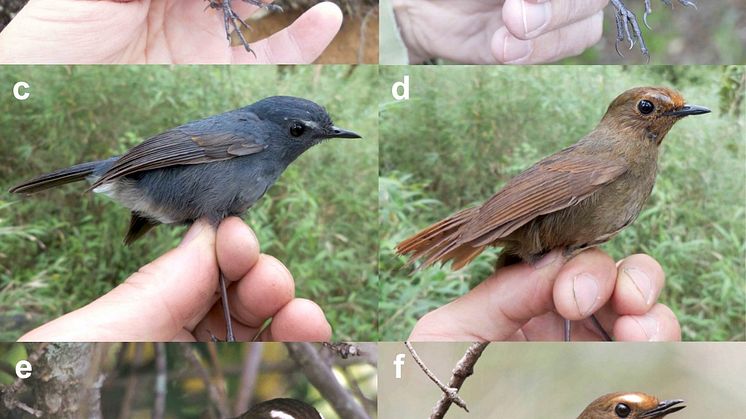
“The new species is a little cryptic and tricky to define. In terms of appearance, it doesn’t differ from the Ijima’s Leaf Warbler. It is DNA analyses and differences in song that show that this is a separate species,” Alström says.
Because the groups of islands where the birds live are small, their populations are tiny. The Tokara Islands have a combined area of just over 100 square kilometres, smaller than that of Fårö (an island off the coast of Gotland), divided between twelve islands.
As both species have very low genetic diversity, they may be vulnerable to changes in nature and the environment as well as to diseases. Yet both species also show signs that they may have recovered somewhat from past population declines.
The Ijima’s Leaf Warbler is already officially listed as Vulnerable by the International Union for Conservation of Nature and is protected as a Japanese “Natural Monument”. As the Tokara Leaf Warbler is at least as rare as the Ijima’s Leaf Warbler, the scientists recommend that both species should be classified as Vulnerable and both should be monitored to detect any future population changes.
Article: Takema Saitoh, Daria Shipilina, Canwei Xia, Lijun Zhang, Shin-Ichi Seki, Urban Olsson6, Per Alström. (2026). Discovering and protecting cryptic biodiversity: a case study of a previously undescribed, vulnerable bird species in Japan. PNAS Nexus, DOI: 10.1093/pnasnexus/pgag037
For more information:
Per Alström, Researcher at Department of Ecology and Genetics; Uppsala University
email: per.alstrom@ebc.uu.se, Phone: +46 70 454 69 65
Related links
Topics
Categories
Founded in 1477, Uppsala University is the oldest university in Sweden. With more than 50,000 students and 7,500 employees in Uppsala and Visby, we are a broad university with research in social sciences, humanities, technology, natural sciences, medicine and pharmacology. Our mission is to conduct education and research of the highest quality and relevance to society on a long-term basis. Uppsala University is regularly ranked among the world’s top universities. www.uu.se