Blog post —
Pear Body Shape: Why You Store Fat in Your Hips and Thighs, and What Can Help
Updated on Nov 17, 2026
Women naturally carry more lower-body fat than men, and this pattern emerges at puberty. After menopause, falling estrogen shifts fat towards the abdomen [2, 5-11]. Lower-body fat offers some metabolic protection, but pear shapes still face higher risks of type 2 diabetes, heart disease and high blood pressure [13]. Pear-shaped women aged 40 to 60 tend to report lower anxiety and depression, but this weakens after menopause [12]. Shapewear and compression garments give only temporary results and can be uncomfortable, while non-invasive devices and “fat-burning” machines have unpredictable or unproven results. Modern liposuction (the MDC-Sculpt® Lipo Technique) is an option with targeted, long-lasting results, with 7 to 14 days of soreness and a return to work within a couple of days. Dr Ivan Puah advises choosing a doctor based on artistic flair, experience and a consistent track record.
Key takeaways
- A pear body shape (triangle body shape, or gynoid obesity) means more fat is stored in the lower body than the upper body. It is mainly driven by estrogen, genetics and metabolism [1].
- Pear-shaped fat distribution offers some metabolic protection, but it still carries risks of type 2 diabetes, heart disease and high blood pressure [13].
- Shapewear gives only temporary results. Non-invasive devices vary widely in results. Liposuction removes fat cells from targeted areas and is the only option here described as delivering permanent results.
- Choose a doctor by experience, artistic skill and a consistent track record of results.
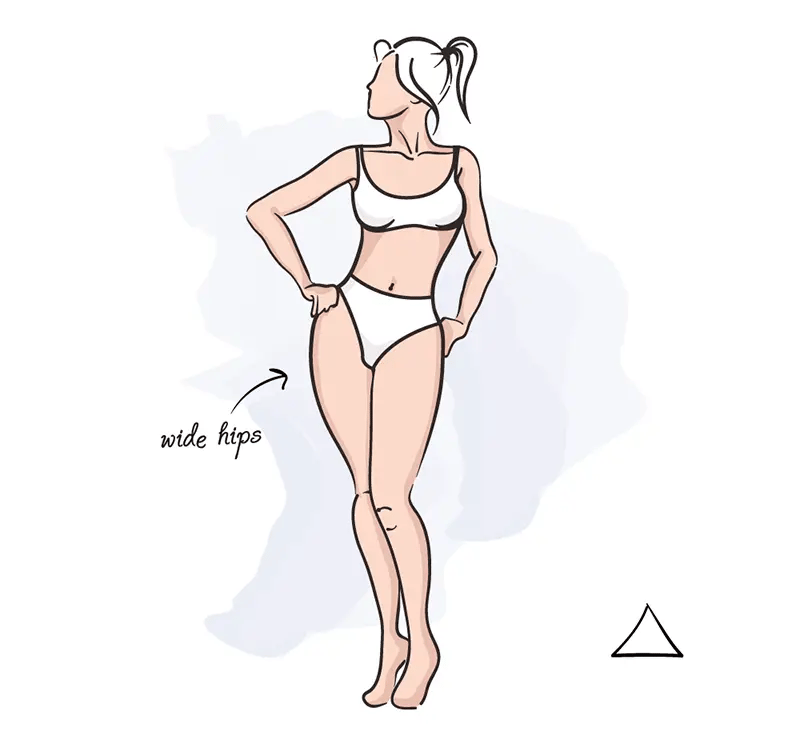
What is a pear body shape (gynoid obesity)?
A pear body shape, also called a triangle body shape, is a pattern where you carry more fat in the lower body than the upper body. In medical terms this is gynoid obesity. It is mainly influenced by hormones, especially estrogen, which promotes fat storage in the lower body. Testosterone, more common in men, leads to fat being stored in the upper body. Genetics and metabolism also play a role [1].
Common characteristics of a pear body shape
- Lower body fat concentration
- Shoulders narrower than hips
- Smaller bust
- Full hips and fuller thighs
- Weight gain that shows first in the hips, thighs and lower midriff
Why do women store more fat in the hips and thighs?
Women generally have a higher body fat percentage than men, with more fat in the hips and thighs. This “female” fat distribution helps protect against type 2 diabetes and atherosclerosis, the buildup of fat, cholesterol and other substances in and on the artery walls [2].
- At the same BMI, women have about 10% more body fat than men [5, 6], and they keep a higher body fat percentage throughout life [7].
- At similar BMI, women also tend to have more subcutaneous fat in both the abdomen and the hips [8, 9, 10, 11].
- During puberty, boys gain weight mainly as muscle, while girls gain it mainly as fat. This is when the male (android) and female (gynoid) fat patterns emerge.
- After menopause, falling estrogen levels shift fat towards the abdomen.
Can men have a pear body shape too?
Yes, though it is less common. Early studies found the pear-shaped distribution mainly in women [3]. By contrast, about 40% of women aged 30 to 79 carry more fat in the abdominal area, which leads to metabolic issues similar to those seen in men [4].
What are the health risks of a pear body shape?
Physical health: A pear shape carries an increased chance of type 2 diabetes, heart disease and high blood pressure [13].
Mental health: Studies found that women aged 40 to 60 with a pear shape tend to report lower symptoms of anxiety and depression. This relationship weakens after menopause, when the body shape shifts towards an apple form [12].
Confidence and quality of life: Many pear-shaped women struggle with body shaming, finding clothes that fit well, or avoiding water activities to skip wearing swimwear. Over time this can lead to low self-esteem, social exclusion and a reduced quality of life.
How can you reduce hip and thigh fat? Comparing your options
| Option | Pros | Cons |
|---|---|---|
| Waist compression garments | Immediate, slight reduction in waist circumference Clothes may fit better |
Temporary Can cause breathing difficulty Uncomfortable Hot in Singapore’s climate Risk of organ and bone damage May weaken core muscles |
| Thigh shapewear | Immediate, slight reduction in thigh circumference Clothes may fit better |
Temporary Breathing difficulty Uncomfortable Hot in our climate |
| Non-invasive treatments | Affordable single session Many treatment choices Minimal downtime Can target multiple areas |
Unpredictable results, if any Not all devices have sufficient clinical testing Costly over multiple sessions Cryolipolysis may cause paradoxical adipose hyperplasia Some devices are not HSA-approved for fat reduction or body contouring May not be operated by a licensed doctor May cause blisters and hyperpigmentation |
| “Fat-burning” machines | Affordable single session Many choices Minimal downtime Can target multiple areas |
No scientifically proven results Costly over multiple sessions May not be operated by a licensed doctor May cause blisters and hyperpigmentation |
| Modern liposuction (MDC-Sculpt® Lipo Technique) | Permanent results Targeted fat removal Multiple areas in one session Customised sculpting Tightens treated skin Minimal scarring and downtime Natural-looking hip and thigh contours |
Soreness for 7 to 14 days Bruising and tenderness (manageable) Itchy incisions while healing Temporary scar discolouration |
What is recovery from hip and thigh liposuction like?
Most patients resume work within a couple of days. Expect soreness for 7 to 14 days, bruising and tenderness in the treated area, itching as incisions heal, and temporary scar discolouration.
How do you choose a liposuction doctor in Singapore?
“Liposuction is 30% science and 70% art form,” says Dr Ivan Puah, Chairman of the Lipo Peer Review Committee Singapore. A deep understanding of each patient’s unique fat distribution is essential for natural-looking results.Modern Liposuction With MDC-Sculpt®️ Lipo Technique goes beyond fat removal. The doctor shapes the fat anatomy to accentuate the patient’s underlying musculoskeletal structure. Look for:
- Artistic flair in body contouring
- Experience, such as 20+ years of body sculpting surgery
- A consistent track record of good results
- MOH accreditation for liposuction
FAQ
What is a pear body shape?
A pear body shape, or gynoid obesity, means you store more fat in your hips, thighs and lower body than in your upper body. It is driven mainly by estrogen, genetics and metabolism [1].
Is a pear body shape healthier than an apple shape?
Lower-body fat offers some protection against type 2 diabetes and artery disease [2], but pear shapes still face higher risks of diabetes, heart disease and high blood pressure [13].
Why can’t I lose hip and thigh fat with diet and exercise?
Estrogen promotes fat storage in the hips and thighs [1], and lower-body fat is influenced by genetics and metabolism. This is why fat there can persist even when you lose weight elsewhere.
Does body shape change after menopause?
Yes. As estrogen falls, fat tends to shift from the hips and thighs towards the abdomen.
What is the most effective treatment for stubborn thigh fat?
Shapewear is temporary, and non-invasive devices give unpredictable results. Modern liposuction removes fat from targeted areas with permanent results when performed by an experienced doctor.
How long is recovery after thigh liposuction?
Soreness can last 7 to 14 days. Most patients return to work within a couple of days.
Explore effective solutions for stubborn hip and thigh fat in pear-shaped women. Expert body sculpting and liposuction services in Singapore.
Reference
[1] Roubenoff R, Kehayias JJ. The meaning and measurement of lean body mass. Nutr Rev. 1991 Jun;49(6):163-75. doi: 10.1111/j.1753-4887.1991.tb03013.x. PMID: 2046978.
[2] Manolopoulos KN, Karpe F, Frayn KN: Gluteofemoral body fat as a determinant of metabolic health. Int J Obes 2010, 34: 949–959. 10.1038/ijo.2009.286
[3] Krotkiewski M, Björntorp P, Sjöström L, Smith U: Impact of obesity on metabolism in men and women. Importance of regional adipose tissue distribution. J Clin Invest 1983, 72: 1150–1162. 10.1172/JCI111040
[4] Jensen MD: Role of body fat distribution and the metabolic complications of obesity. J Clin Endocrinol Metab 2008,93(11 Suppl 1):S57-S63.
[5] Womersley J, Durnin JVGA: A comparison of the skinfold method with extent of overweight and various weight–height relationships in the assessment of obesity. Br J Nutr 1977, 38: 271–284. 10.1079/BJN19770088
[6] Jackson AS, Stanforth PR, Gagnon J, Rankinen T, Leon AS, Rao DC, Skinner JS, Bouchard C, Wilmore JH: The effect of sex, age and race on estimating percentage body fat from body mass index: The Heritage Family Study. Int J Obes Relat Metab Disord 2002, 26: 789–796.
[7] Gallagher D, Visser M, Sepúlveda D, Pierson RN, Harris T, Heymsfield SB: How useful is body mass index for comparison of body fatness across age, sex, and ethnic groups? Am J Epidemiol 1996, 143: 228–239. 10.1093/oxfordjournals.aje.a008733
[8] Camhi SM, Bray GA, Bouchard C, Greenway FL, Johnson WD, Newton RL, Ravussin E, Ryan DH, Smith SR, Katzmarzyk PT: The relationship of waist circumference and BMI to visceral, subcutaneous, and total body fat: sex and race differences. Obesity (Silver Spring) 2011, 19: 402–408. 10.1038/oby.2010.248
[9] Schreiner PJ, Terry JG, Evans GW, Hinson WH, Crouse JR, Heiss G: Sex-specific associations of magnetic resonance imaging-derived intra-abdominal and subcutaneous fat areas with conventional anthropometric indices. The Atherosclerosis Risk in Communities Study. Am J Epidemiol 1996, 144: 335–345. 10.1093/oxfordjournals.aje.a008934
[10] Després JP, Couillard C, Gagnon J, Bergeron J, Leon AS, Rao DC, Skinner JS, Wilmore JH, Bouchard C: Race, visceral adipose tissue, plasma lipids, and lipoprotein lipase activity in men and women: the Health, Risk Factors, Exercise Training, and Genetics (HERITAGE) family study. Arterioscler Thromb Vasc Biol 2000, 20: 1932–1938. 10.1161/01.ATV.20.8.1932
[11] Demerath EW, Sun SS, Rogers N, Lee M, Reed D, Choh AC, Couch W, Czerwinski SA, Chumlea WC, Siervogel RM, Towne B: Anatomical patterning of visceral adipose tissue: race, sex, and age variation. Obesity (Silver Spring) 2007, 15: 2984–2993. 10.1038/oby.2007.356
[12] Rioli G, Mattei G, Ferrari S, et al. Apple or Pear? a Cross-sectional Study On the Association Between Body Shape and Symptoms of Anxiety and Depression in Primary Care Female Patients. European Psychiatry. 2015;30(S1):1-1. doi:10.1016/S0924-9338(15)30252-2
[13] Després JP, Moorjani S, Lupien PJ, Tremblay A, Nadeau A, Bouchard C. Regional distribution of body fat, plasma lipoproteins, and cardiovascular disease. Arteriosclerosis. 1990 Jul-Aug;10(4):497-511. doi: 10.1161/01.atv.10.4.497. PMID: 2196040.