
News —
Pseudogynecomastia Surgery Recovery Timeline: Day-by-Day Guide (Singapore)
Updated on Aug 4, 2026
Most patients return to desk work within 2–4 days, resume light exercise by week 2–3, and see final results by month 3–6. Swelling, bruising, and mild fluid drainage are normal in the first two weeks; fever, pus, or spreading redness are not and need immediate medical attention.
Pseudogynecomastia (also called fake gynecomastia or lipomastia) is caused by fat accumulation in the chest, most often seen in overweight men. When diet and exercise haven't resolved it, pseudogynecomastia surgery with Vaser lipo is the most effective way to remove stubborn chest fat permanently. Recovery follows a similar path to liposuction elsewhere on the body, with a few chest-specific differences, mainly around compression vest use and upper-body movement.
This guide breaks the recovery down day by day so you know exactly what to expect, what's normal, and what warrants a call to your doctor.
Key Takeaways
- Days 1–4 post-surgery are the toughest, with pain peaking on Day 1 and swelling and bruising expected for the first week.
- Most return to desk jobs by Days 2–4 while wearing a compression vest. This vest is essential for 18+ hours a day for weeks 2–3 and into month 2, as it reduces swelling and shapes the final contour.
- Distinguish between normal healing signs (clear fluid and itching) and issues needing immediate attention (pus, fever, or spreading redness).
- Light walking is encouraged within a week, but avoid chest exercises until week 4–6 with doctor approval.
- Final results may take 3 to 6 months as swelling resolves and skin retracts, so don't judge results too early, even at weeks 3–4.
Is it normal to feel groggy and sore right after surgery?
Yes, this is expected and temporary. You'll stay in a recovery room for a few hours for observation while the anaesthesia wears off. Have a trusted companion drive you home; do not drive yourself.
What happens immediately after surgery:
- Initial contouring results are already visible, though swelling will change the shape over the coming weeks
- Wound dressings and your elastic compression vest are fitted and worn from this point on [1]
- Avoid alcohol and smoking, both slow healing
- Follow an anti-inflammatory diet (fatty fish, healthy fats, whole grains) through recovery
- Rest as much as possible for the first 2 weeks [2]
- You may shower the same night with unscented, gentle body wash, cover dressings with plastic to keep them dry
- Sleep in your compression vest, positioned away from the treated area
- Take only doctor-prescribed medication
Day 1: Is pain supposed to peak now?
Yes, Day 1 is typically when discomfort is at its worst, and this is manageable with prescribed painkillers, it is not a sign of a problem on its own.
- Keep the surgical area clean and dry, and change dressings gently as instructed
- Handle sutures carefully, never pull or cut them yourself
- Your doctor may prescribe oral antibiotics (typically a 5-day course) to prevent infection [8]
Day 2 – 4: When can I go back to work?
Most patients return to desk work by Day 2–4, wearing the compression vest underneath their shirt (this is mandatory, not optional).
Safe during this window:
- Light activities and simple housework
Avoid during this window:
- Heavy lifting, especially overhead or from high shelves [2]
- Gym training or water activities of any kind until your doctor clears you
What's normal: Continued swelling and bruising, and clear, thin fluid (serous drainage) from the incisions, this is your body clearing the area and supporting healing.
Contact your medical team immediately if you notice: pus from the wound, fever, or increased redness that's tender to the touch. These are the specific warning signs of infection, not routine post-op symptoms.
Day 5 – 7: Fluid is still draining, should I be worried?
Ongoing light fluid drainage through Day 5–7 is still considered normal. Pain and swelling should be noticeably easing by now, though continued painkiller use is fine if needed.
- Light walking around the house is encouraged as gentle movement
- Lower-body stretching is fine; avoid upper-body stretching
- Keep the wound clean, dry, and free of significant irritation
- Do not miss your follow-up appointment this week, your doctor needs to check healing progress and catch any red flags early
Week 2 – 3 (Day 8 – 21): Gradual return to activity
Pain should have almost fully subsided by this stage, with only residual swelling remaining. If your job involves heavy physical movement (climbing, heavy mobility), get explicit doctor clearance before returning.
- Continue avoiding heavy lifting and any exercise involving chest muscles
- Wear the compression vest at least 18 hours a day [2]
- Attend your second follow-up consultation around the 3-week mark
- Your doctor may recommend Manual Lymphatic Drainage (MLD) massage to support circulation
- Stitches may be removed during this period
- Start scar treatment (medical-grade silicone gel or sheet) once cleared
Week 4–6 (Day 22–42): Skin tightening phase
Most daily activities can fully resume during this window, unless your doctor says otherwise [3]
- Pectoral and upper-limb exercises may begin, pending approval [2]
- Keep the compression vest on through month 2 [4], especially during workouts
- Numbness or sensitivity around the incision site typically starts resolving
- Swelling and wound fluid should have mostly settled by now
- Itchiness at this stage is a good sign, it means the skin is healing. Over-the-counter antihistamines can help if it's bothersome
- Continue MLD massage and silicone scar gel
Month 3 – 6: When will I see my final results?
Final results from pseudogynecomastia surgery typically take 3–6 months to fully settle, as swelling resolves completely and skin retracts to the new chest contour.
- Compression vest use can usually be reduced based on comfort and doctor guidance
- Apply sunblock to incision sites whenever outdoors, UV rays penetrate regular shirt fabric and can worsen scarring
- Continue silicone scar gel diligently
- Keep attending follow-ups and raise any lingering concerns with your doctor
Compression Vest: What You Need to Know
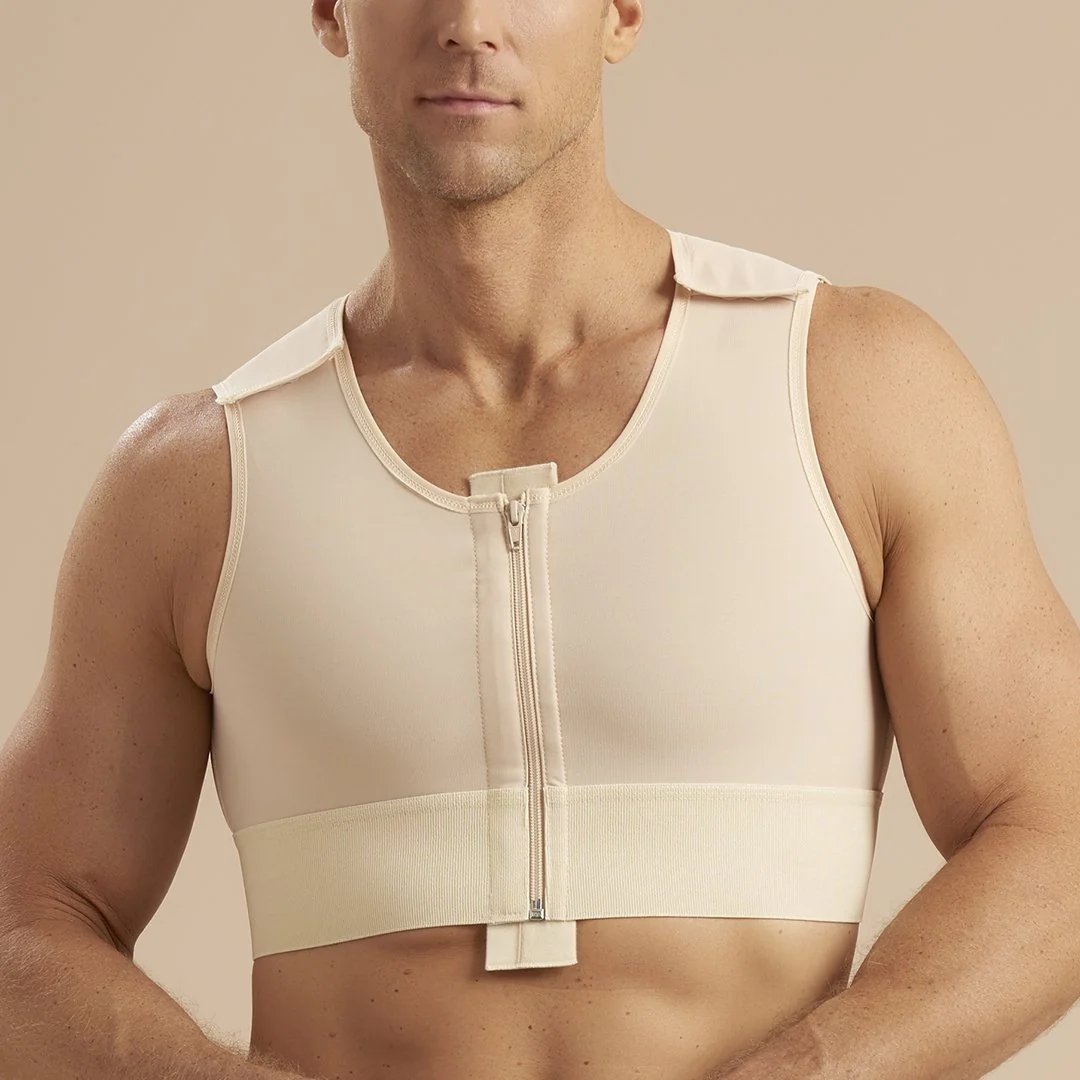
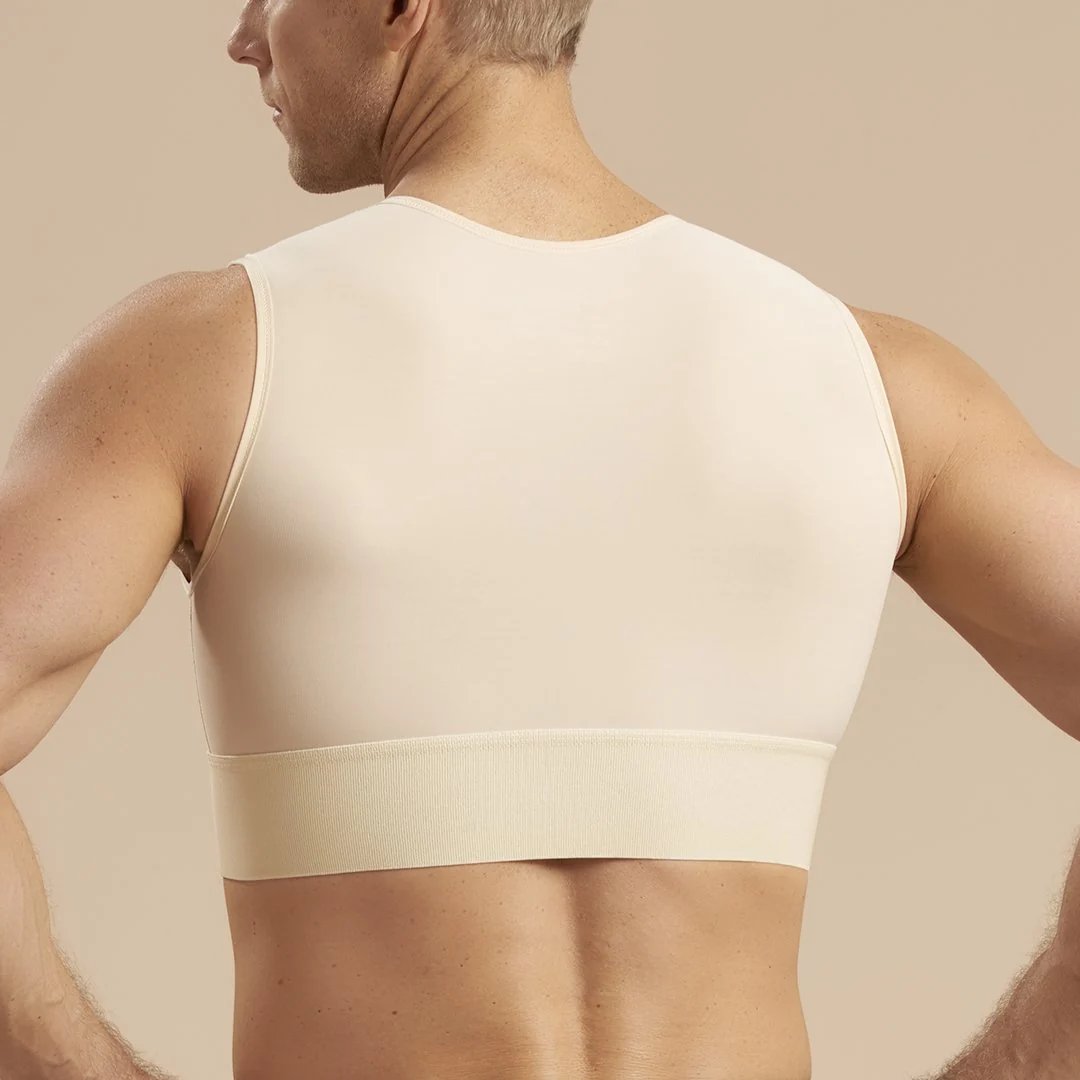
Why it matters: A compression vest applies consistent, even pressure that reduces swelling, lowers the risk of complications, and helps the chest heal into its new contour. At Amaris B. Clinic, a compression vest (rather than an elastic band) is recommended because it gives full chest coverage without bunching at the waist, particularly helpful for men with shorter torsos.
| Benefit | How it helps |
|---|---|
| Minimises swelling | Consistent pressure reduces fluid buildup and tissue oedema [5] |
| Reduces complication risk | Lowers risk of seroma and haematoma formation [6] |
| Promotes healing | Supports the surgical site and skin integrity |
| Maintains contour | Holds tissue in place to support the final shape [7] |
| Pain relief | Reduces discomfort at the treated area [2] |
How to choose the right size
Do not use your regular shirt size, compression garment sizing is different from everyday clothing and runs on its own chart.
- Measure your current body dimensions rather than guessing
- Check the specific size chart for this garment style
- If between sizes, size up
- Ask the clinic's medical team if you're unsure
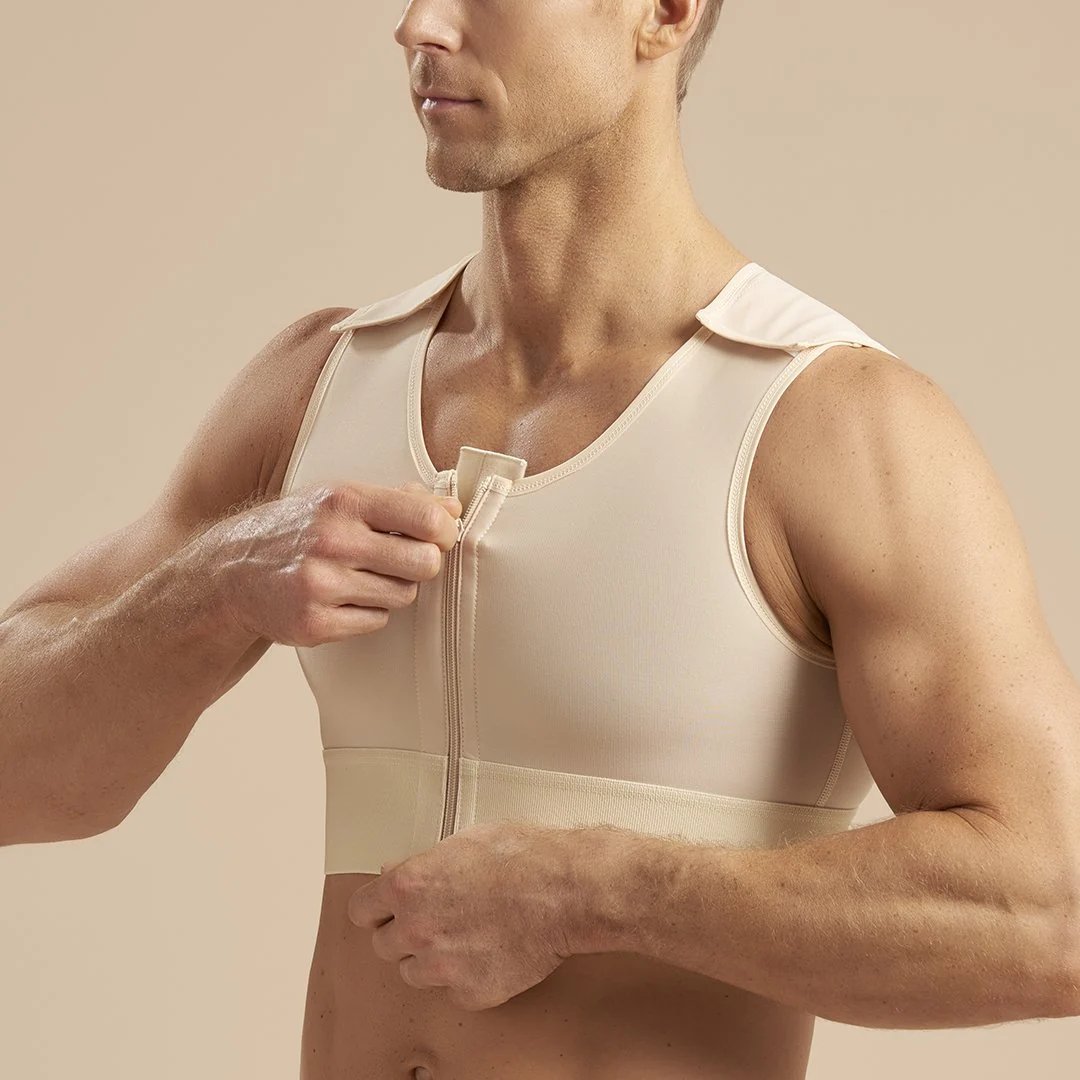
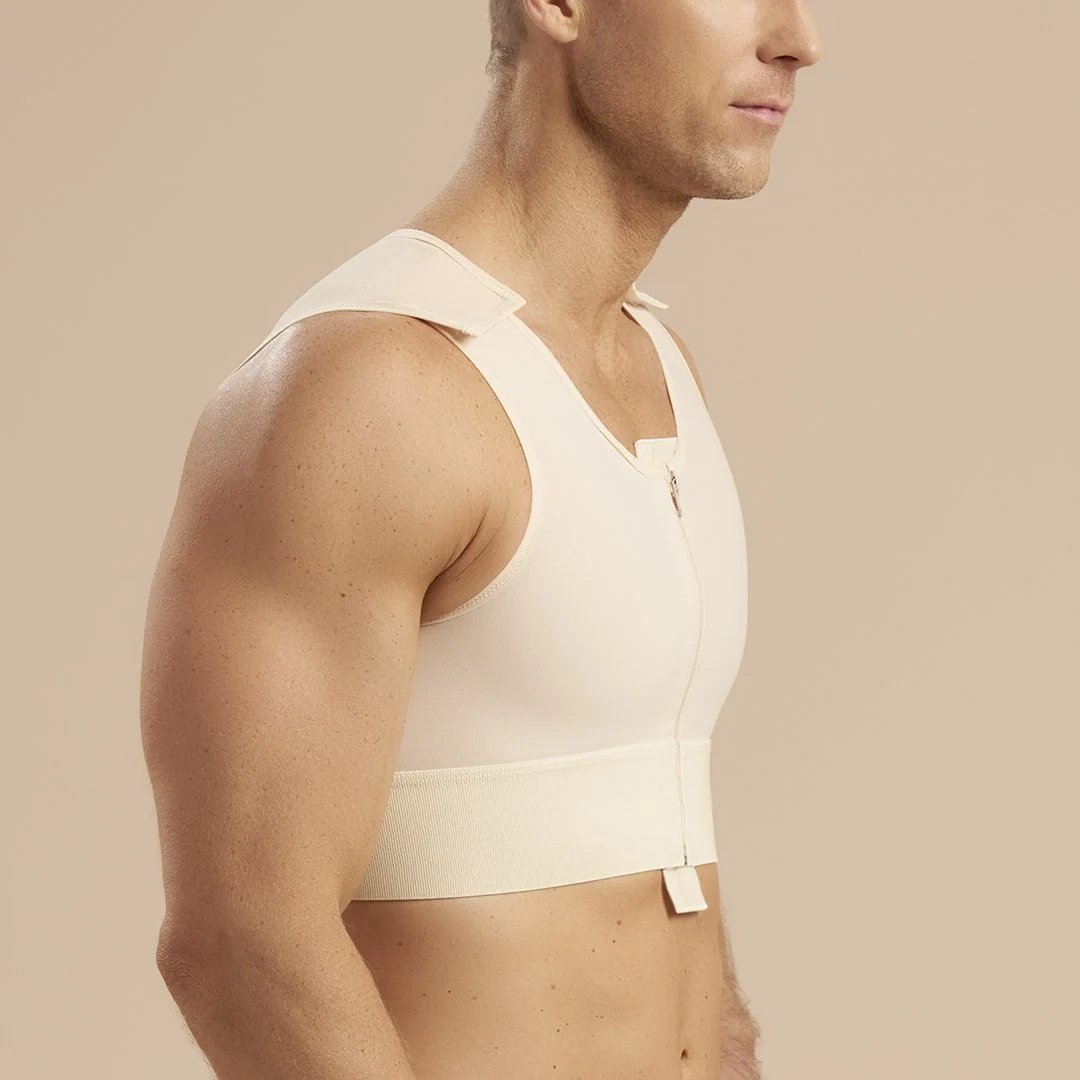
Caring for your compression vest
- Turn inside out before washing
- Machine wash ≤30°C on a gentle cycle with mild detergent
- Tumble dry only, no ironing, steaming, or direct heat
- No bleach or fabric softener
- Replace it once it loses elasticity or shows visible wear
Activity Restrictions Timeline
| Timeframe | Avoid | Why |
|---|---|---|
| Day 0–14 | Weightlifting, running, aerobics, HIIT, padel, contact sports (basketball, football, martial arts) | Strains chest muscles and risks impact injury to the surgical site |
| Day 0–14 | Swimming, hot tubs, saunas, jacuzzis | Raises infection and irritation risk at incisions |
| Day 0–14 | Smoking, alcohol, poor sleep, late nights | Impairs circulation and delays healing |
| Week 2–4 | Push-ups, bench presses, upper-body resistance training | Chest tissue is still healing and not ready for muscle-building load |
| Week 2–4 | Sprinting, jumping jacks | High-impact movement risks swelling flare-ups |
| Week 2–4 | Sun exposure, thin white shirts | UV exposure increases pigmentation and scarring risk |
| Week 4–8 | Intense cardio, full-contact sports, heavy weightlifting | Needs explicit doctor clearance before resuming |
Manual Lymphatic Drainage (MLD): Does it actually speed up recovery?
Yes, MLD massage is commonly recommended because surgery temporarily disrupts local lymphatic pathways, and scar tissue can create longer-term blockages. Gentle, rhythmic MLD strokes stimulate lymph flow, which helps:
- Reduce swelling and bruising
- Release localised fluid retention in the chest
- Improve nutrient delivery to the surgical site
- Support tissue repair and toxin clearance
- Reduce post-operative discomfort overall
FAQ
Is pseudogynecomastia the same as gynecomastia?
No. They look similar but differ in cause. Pseudogynecomastia (lipomastia) is purely fat accumulation with no glandular tissue involved. True gynecomastia is glandular tissue enlargement only, while mixed gynecomastia, the most common presentation, combines both fat and glandular (subareolar fibrous) tissue.
Is pseudogynecomastia common in Singapore?
It's actually less common than true or mixed gynecomastia, most men with enlarged chest tissue have the mixed type. Regardless of type, the condition affects men from their teens through their 50s and beyond, and often has a real psychological impact alongside the physical one.
How do I know if I have pseudogynecomastia and not true gynecomastia?
With pseudogynecomastia, there's no firm glandular ring under the nipple on palpation, the tissue feels loose and fatty. Chest size tends to track your overall body weight, changing as your weight fluctuates.
Can diet and exercise fix pseudogynecomastia without surgery?
Partially, in many cases. Diet and exercise are the recommended first step and can meaningfully reduce chest fat. When they plateau and stubborn fat remains, liposuction is the next step, since it can permanently remove fat that hasn't responded to lifestyle changes.
Does eating prawns make the wound itchy? Does soy sauce darken scars?
No, these are traditional beliefs, not a medical fact. Post-surgical itchiness is a normal sign of nerve and tissue regeneration regardless of diet. Scar darkening (hyperpigmentation) depends on genetic scarring tendency and how well the wound is cared for, not on any specific food.
When should I call my doctor instead of waiting it out?
Contact your medical team immediately if you notice pus, fever, or spreading redness/tenderness at the incision site. These are outside the range of normal post-op swelling, bruising, or light fluid drainage.
How long until I can exercise normally again?
Light walking is fine from Day 5–7. Lower-body movement resumes around week 1. Upper-body and chest-specific exercise generally isn't cleared until week 4–6, and intense cardio or full-contact sport not until week 4–8, always with your doctor's sign-off first.
Reference
- Wound management and compression garment protocols, Aesthetic Surgery Journal Wenshan Xing, Cong Liu, Lin Chen, Zhengyao Li, Jinlong Zheng, Improving Surgical Treatment for Severe Gynecomastia and Avoiding Skin Resection: Skin Redistribution and Fixation Approach for Aesthetic Excellence, Aesthetic Surgery Journal, Volume 46, Issue 3, March 2026, Pages 260–268, https://doi.org/10.1093/asj/sjaf193
- Post-liposuction recovery guidelines, PMC Pinelli M, De Maria F, Ceccarelli P, Pedrieri B, Bianchini MA, Iughetti L, De Santis G. Gynecomastia: an uncommon, destabilizing condition of the male adolescent. our therapeutic choice. Acta Biomed. 2023 Apr 24;94(2):e2023055. doi: 10.23750/abm.v94i2.14028. PMID: 37092627; PMCID: PMC10210576.
- Return to activity after body contouring, Springer Hu, M.S., Brower, J., Joseph, W.J., Rubin, J.P. (2026). The Male Chest After Massive Weight Loss. In: Jeffords, K., Manders, E.K., Austen, Jr., W.G. (eds) Aesthetic Surgery for Men. Springer, Cham. https://doi.org/10.1007/978-3-032-03840-1_25
- Compression garment duration recommendations, Aesthetic Plastic Surgery Affara, M.F.K.F., Badawy, M.S., Reyad, K.A. et al. Simultaneous Treatment of Pseudo-gynecomastia and Lateral Chest in Patients with Massive Weight Loss. Aesth Plast Surg 49, 2015–2022 (2025). Compression therapy and swelling reduction, ASJ Open Forum Krista" target="_blank" class="redactor-autoparser-object">https://doi.org/10.1007/s00266... L Hardy, Ran Stark, Kevin H Small, Jeffrey M Kenkel, An Alternative Treatment of Pseudogynecomastia in Male Patients After Massive Weight Loss, Aesthetic Surgery Journal Open Forum, Volume 2, Issue 2, June 2020, ojaa013, https://doi.org/10.1093/asjof/ojaa013
- Seroma and haematoma risk reduction, SAGE Journals Vadodaria, S., Nimavet, S., & Chowdhury, M. (2025). Ensuring Safety in Gynaecomastia Surgery at a ‘Stand-alone Aesthetic Surgery Day-case Centre’in the United Kingdom: A New Component-based Classification and Practical Management Tips for Anabolic Androgenic Steroid (AAS)-induced Gynaecomastia. International Journal of Aesthetic Plastic Surgery, 1(2), 140-150.
- Compression garments and contour maintenance, BMC Endocrine Disorders Diao, X., Wang, M., Chen, D. et al. A comparative study on the short-term and long-term efficacy of endoscopic lipolysis, liposuction, and traditional open excision in gynecomastia treatment. BMC Endocr Disord 25, 48 (2025). https://doi.org/10.1186/s12902-025-01876-6
- Post-operative antibiotic protocols, Aesthetic Plastic Surgery Tettamanzi, M., Filigheddu, E., Ziani, F. et al. Optimizing Gynecomastia Correction Surgery: Efficacy and Safety of Tumescent Local Anesthesia Approach. Aesth Plast Surg 48, 5067–5073 (2024). https://doi.org/10.1007/s00266-024-04404-4
