News —
From Chernobyl to Global Leader – Radonova Celebrates 40 Years
As Radonova celebrates its 40th anniversary this year, it also marks a legacy built upon scientific research, societal needs and technological development. The company’s origins date back to 1986 as a response to the Chernobyl nuclear accident. In the wake of the disaster, a research group at Uppsala University in Sweden founded Gammadata Mätteknik to address an urgent need: measuring radioactive fallout, specifically in cesium, within the environment and food supply.
The situation called for innovation and new solutions. By developing proprietary measurement systems and using mainframe technology of the time, custom-built databases enabled the laboratory to handle large volumes of samples and analyze up to 1,500 cesium samples per day, including reindeer meat from the most heavily affected areas.
“There was a major demand for knowledge after the Chernobyl accident, and we quickly realised that a gamma spectrometer adapted for upper-secondary education would help teachers and students better understand how cesium measurements are carried out on food samples. That is why we developed a system with automated analysis routines, enabling students to test their own samples,” says Dag Sedin, who was Product Manager at Gammadata Mätteknik.
From Cesium to Radon – 1980s to 2000s
Towards the end of the 1980s, the company gradually began shifting its focus. Experience gained from cesium measurements, particularly in analysis, database management and quality assurance became the foundation for the next major area: radon measurement.
By the late 1980s, the company started working with passive radon detectors based on track-etch film analysis, a technology that still underpins today’s radon detectors. The development of databases and analytical processes continued, making it possible to manage large sample volumes with high levels of traceability and quality.
During the 1990s, the systems were further refined. The database was developed with a clear focus on long-term traceability and quality, which has largely laid the foundation for the company’s current operations.
“The business was founded at a time when society had a very concrete need for radon measurements and knowledge. That combination of research, technology and societal benefit still defines Radonova today,” says CEO Karl Nilsson, who joined the company in 2010.
“The fact that our founders built our systems correctly from the start has been crucial. It has enabled us to grow without compromising quality or traceability,” he adds.
Quality and Accreditation
An important part of the company’s development has been its long-term commitment to quality assurance. Radonova, and previously Gammadata, has been performing accredited radon measurements for more than 30 years. Accreditation means that methods, processes and quality systems are regularly reviewed in accordance with international standards.
This long-term focus on quality has been a key factor in building trust among authorities, businesses and society as a whole.
Since its inception, the company has also maintained close ties to research and education. Collaborations with schools and universities have been a natural part of its operations as well as sharing knowledge about measurement, radiation and environmental issues with new generations.
A New Phase and International Expansion
In the early 2000s radon received less public attention, but the situation changed in 2009 when the business was acquired by Landauer Nordic. In 2015 the company became part of the Lagercrantz Group and adopted its current name, Radonova.
This marked the beginning of a period of clear international expansion.
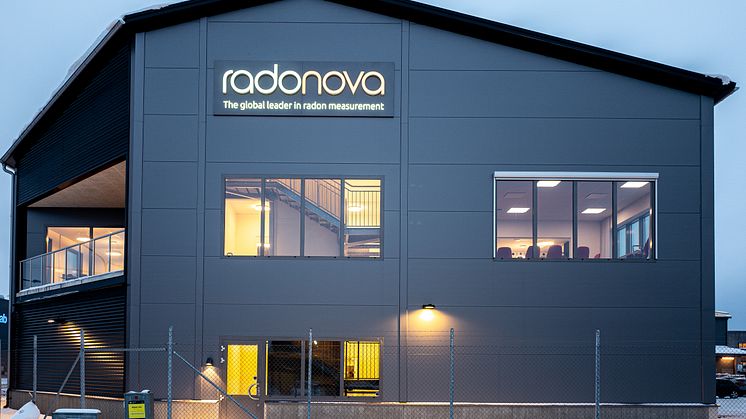
Today, Radonova is the world’s leading laboratory for radon measurement, serving customers in more than 80 countries and operating offices in the United States, the United Kingdom, Germany, France and Norway. The company’s operations include production, analysis, sales, support, as well as research and development, with headquarters and laboratories located in Uppsala, Sweden.
Automation Enables Global Growth
One key explanation for the company’s growth is the high level of automation in its laboratory operations. Over many years, Radonova has continuously developed its analytical processes to handle large volumes without compromising precision or quality.
Today, the company can produce up to 50,000 radon detectors within ten days and analyse approximately 4,000 to 5,000 samples per day. This automation makes it possible to scale production and meet demand from a growing international market.
“One major change over these 40 years is that radon measurement has become far more accessible. What was once relatively complex and costly is now simple to carry out, both for private individuals and organisations,” says Karl Nilsson.
Knowledge for the Future
Today radon is an established part of efforts to improve indoor environments and public health. However, there remains a significant need for knowledge and measurement, both in Sweden and internationally.
For Radonova, the next chapter is not only about technology and analysis, but also about continuing to share knowledge.
“Our mission is fundamentally the same as when everything began: to provide reliable measurements and knowledge. This is essential for enabling people to make well-informed decisions about their environment and their health,” Karl Nilsson concludes.